

A good YouTube channel idea is one you can make 50 videos about, for a viewer you can describe in one sentence. The ideas below are grouped by type, and each one says why it can earn and what you could sell to the same audience later.
Every group below names who watches, an example video, how the idea earns, and what you could sell the same audience later. None of them carries an earnings figure: YouTube publishes no per-topic or per-view rate, so any list that promises a number for “cooking” or “tech” is guessing.
Teaching a skill people use at work
Who watches: someone with a problem at their desk today, where solving it saves time or helps them get a job.
| Idea | Exactly who | What you could sell later |
|---|---|---|
| Excel and Google Sheets for office work | Accountants, admin staff, students | A course from basics to reports and dashboards |
| Tally and GST filing basics | Small business owners, commerce students | A step-by-step course on one full year of accounts |
| Coding for beginners (Python, web basics) | College students, career changers | A project course: build one real app, start to finish |
| Spoken English for interviews | Job seekers, graduates | A 30-lesson speaking course with practice tasks |
| Graphic design with free tools (Canva, GIMP) | Small shop owners, freelancers | A course on making a full brand kit |
| Video editing on a phone | New creators | A course that edits one full video, step by step |
An example video: “Clean a messy exported sheet in 6 minutes” — one task, start to finish, with the file on screen.
How it earns: software companies and course platforms sponsor this kind of channel, because the viewer is someone who buys tools. Affiliate links fit too, since a tutorial naturally ends with “here is the tool I used”, and these viewers already treat learning as something worth paying for.
The catch: search-driven tutorials can feel the same from video to video, and YouTube’s monetization policies ask for content that is materially varied between videos. A series is fine; twenty copies of one video with a new title are not.
Exam and study help
Who watches: a student preparing for one named exam — school boards, entrance exams, government jobs — who returns almost daily.
Ideas: one subject at one level (“Class 10 math in Hindi”, not “education”); previous-year paper walkthroughs, one paper per video, solved slowly; study method channels on planning, revising and note-taking.
An example video: “2025 paper, question 7 to 12, solved on paper in real time.”
How it earns: long watch times and a loyal, returning audience, which is what fan funding rewards. Memberships and Super Thanks open at the 500-subscriber tier (the thresholds are in our guide to the monetization rules).
What you could sell later: a structured course for one exam, lessons in order with notes. The free videos answer single questions; the course takes a student through the whole syllabus.
Hobbies and crafts
Who watches: someone who wants to do the thing this weekend, not just see it done.
Ideas: cooking one cuisine or one kind of dish (tiffin recipes, millet cooking, baking without an oven); drawing, painting or mehndi design; learning an instrument; gardening on a balcony or terrace; sewing and tailoring at home.
An example video: “Three tiffin boxes from one hour of Sunday cooking.”
How it earns: brand deals for ingredients, tools and materials, and affiliate links for the gear you use. These channels suit Shorts well, because a finished dish or drawing reads in a few seconds.
What you could sell later: a beginner course that goes in order. A guitar viewer who watched 30 random lessons still does not know what to practice next. A course that says “week 1, week 2, week 3” solves that.
Faceless channels
Who watches: the same viewers as any other group here — faceless is a format, not an audience. Showing no face breaks no rule. What matters is that the content is yours.
An example video: “Set up your first invoice template”, screen-recorded, your voice over it.
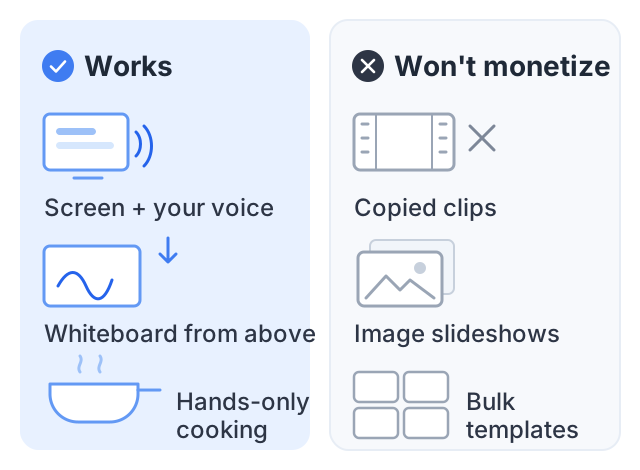
Faceless ideas that work:
- Screen-recorded tutorials with your own voice explaining each step
- Whiteboard or handwritten explanations filmed from above
- Hands-only cooking or craft videos
- Explainers with your own research and script, read in your own voice
Faceless ideas to avoid if you want to earn from ads:
- Clips from films, TV or other creators, edited together with little or no commentary
- Videos that only read out text from websites or news feeds
- Image slideshows or scrolling text with no narrative
- AI-made videos from a generic template, uploaded in bulk
Every item on that second list is named in YouTube’s monetization policies as something that cannot monetize, and those policies are judged on the channel as a whole. Our guide to the policy for AI content goes through each one.
How it earns, and what you could sell later: exactly as the group it belongs to. Your voice and your method are what people pay for, not your face.
Money, career and business
Who watches: someone about to make a decision that involves money, usually this month.
Ideas: freelancing for beginners (finding a first client, writing a proposal, setting a price); starting a small online business; interview preparation for one field such as banking, IT support or nursing; personal finance basics like budgeting and reading a pay stub.
An example video: “The proposal that got me my first ₹10,000 client, line by line.”
How it earns: brands that sell into those decisions sponsor this kind of content, and the audience converts well to a paid product.
The catch: money topics need care. YouTube’s advertiser-friendly content guidelines cover topics like harmful or misleading content, and a video that promises fast returns can lose ads. Teach how things work. Do not promise results.
What you could sell later: a practical course, such as “your first freelance client in 30 days” with templates for each step.
Local, language and culture
Who watches: someone who would rather learn in the language they think in, or who has just moved somewhere new.
Ideas: any skill above taught in Tamil, Telugu, Marathi, Bengali or another language; a city or region guide for newcomers; learning a language, such as German for Indian students.
An example video: “Opening a bank account after you move: what to bring.”
How it earns: a smaller language audience often has fewer channels serving it, so you compete with fewer people for the same viewer and the same sponsor.
What you could sell later: a language course is one of the clearest “paid version” products there is. It has a start, levels and an end.
Channels that are harder to turn into a product
Honesty matters here. Some ideas are fun and can grow, but they are hard to sell a course to:
- Daily vlogs, pranks and reaction channels. People watch you, not a skill. These earn mainly from ads, brand deals and fan funding. Reaction videos also need real commentary to pass the reused content policy.
- News and “top 10” compilations. Hard to keep original, and easy to fall into reused content.
- Kids channels. Every creator must tell YouTube whether a video is made for kids, and YouTube says getting it right is your legal responsibility. Made-for-kids content is also judged against separate quality principles for monetization.
None of these are bad choices. They just depend on YouTube’s own programs more than a teaching channel does.
A worked example
Take Priya, an accounts assistant in Pune. She is good at Excel, and her colleagues keep asking her the same questions.
The idea: “Excel for office work, in simple English, for people who learned it on the job.” The viewer is one person: an office worker who uses Excel daily but was never taught properly.
The first 10 videos: VLOOKUP, pivot tables, cleaning messy data, a monthly expense report, conditional formatting, and five more she has answered for colleagues. Each video is a different task, so the channel is varied by nature.
How it can earn:
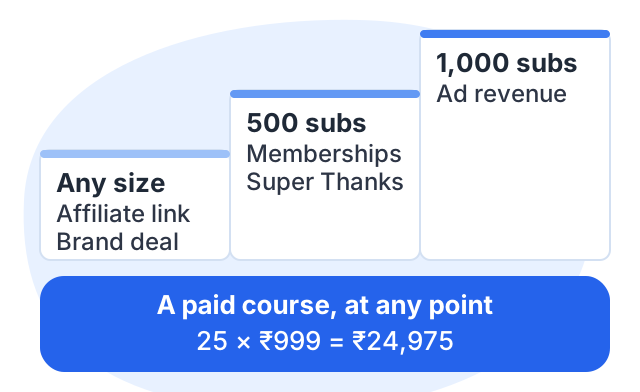
- Before any threshold: an affiliate link to the course she learned from, and a brand deal if a software company wants to reach office workers.
- At 500 subscribers, with the watch-time or Shorts requirement met: memberships and Super Thanks through the expanded Partner Program.
- At 1,000 subscribers with 4,000 qualified watch hours: ad revenue. A channel applying from February 1, 2027 needs 8,000 hours in 365 days (or 20 million Shorts views in 90 days) instead.
- At any point: a paid course, “Excel reports from scratch”, built from the videos she has already made.
Notice that option 4 does not wait for options 2 or 3. If 25 viewers each pay ₹999 for the course, that is ₹24,975 — arithmetic from a price Priya sets and a number of buyers assumed for the example, not an average or a forecast.
How to choose between ideas
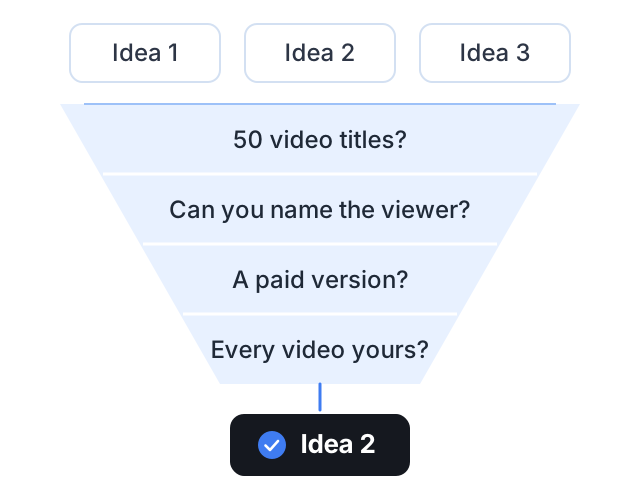
Write down three ideas. For each one, answer:
- Can I list 50 video titles right now? If the list dries up at 12, the idea may be narrower than it looked, or you may not know it well enough yet.
- Can I name the viewer? “Nursing students preparing for interviews” is a viewer. “People who like health” is not.
- Is there a paid version? Would someone pay for the full, organized lesson after watching ten free ones?
- Is every video mine? If the idea depends on other people’s clips, check the reused content policy first.
The idea that passes all four is usually the right one, even if it sounds less exciting than the others.
Another way to earn: sell a course
Every “sell later” column above is the same product: the organized version of what the channel gives away. Courselink imports a YouTube playlist as lessons in order, and students pay into your own Stripe or Razorpay account with 0% taken by Courselink. You can build the course free, but the Free plan cannot sell — paid courses start on Lite at $19 a month (₹1,499), and your own domain on Standard. See pricing for what each plan includes.
For the other routes that need no threshold, see making money on YouTube without monetization.
Sources
- YouTube channel monetization policies: original and authentic content, reused content, and the July 2025 rename of “repetitious content” to “inauthentic content”.
- Advertiser-friendly content guidelines: the topics that can limit ads on a video.
- Determining if your content is made for kids: the audience setting every creator must choose.
- Overview of the expanded YouTube Partner Program: the 500-subscriber tier and the countries where it is available, including India.
This guide makes no claim about what any topic earns from ads, because YouTube publishes no per-topic or per-view rate. The course figure is arithmetic from a stated price and a stated number of buyers.