

YouTube does not ban AI content from making money. It refuses monetization to channels whose videos are generic, repetitive, reused or made only to shock, whether a person or an AI tool made them, and to channels where an AI persona poses as a human expert on sensitive topics. Separately, it requires creators to disclose realistic AI content, which by itself does not reduce earnings.
So there are two separate rules to know. One decides whether your channel can earn. The other decides whether a video needs a label. People mix them up, and that is where most of the confusion comes from.
This guide was updated for YouTube’s July 2026 rewrite. In July 2026 YouTube restructured its channel monetization policies. The old “inauthentic content” section became “Generic or repetitive content”, and two new sections were added: “Unsatisfying or off-putting content” and “AI personas related to sensitive topics”. All of it is covered below.
The two rules at a glance
| Monetization policies | AI disclosure | |
|---|---|---|
| What it checks | Is the content original, authentic and satisfying to watch? | Does realistic content come from AI? |
| Applies to | Your channel as a whole | Each video |
| What happens if you break it | Monetization can be turned off for the whole channel | A label can be added for you, and repeated failure can lead to penalties |
| Does following it cost you money? | No | No. YouTube says disclosure alone does not limit reach or earnings |
Both come from YouTube’s own Help Center: the channel monetization policies and the page on disclosing use of GenAI content. YouTube’s Community Guidelines also apply to all content, including AI content.
Rule 1: the monetization policies
YouTube’s monetization policies say your content should be “original and authentic”. In practice, it should be:
- Your own creation. If you borrow from someone else, you need to change it significantly.
- Not mass-produced, generic, repetitive or manipulative. It should be made to entertain or educate viewers, not only to get views.
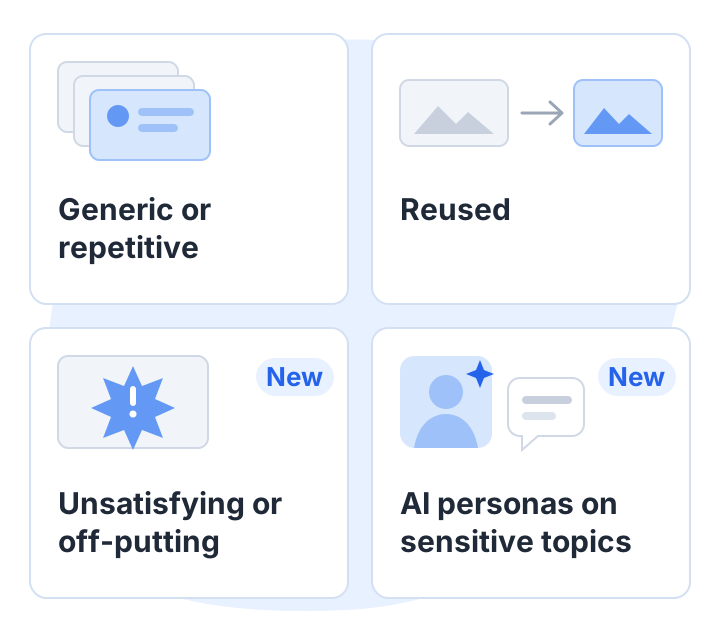
The words “generic” and “manipulative” were added in the July 2026 rewrite. AI is not named as a problem in itself. What YouTube names are patterns of content, and AI makes those patterns cheap to produce. There are now four policies to know.
1. Generic or repetitive content
This is the policy that used to be called “inauthentic content”, and before July 2025, “repetitious content”. If an old notice or video mentions “inauthentic content”, this is the section it means. YouTube describes it as content that looks like it is made with a template, or that may feel repetitive to viewers after watching several videos in a row from the same channel.
The policy page lists examples of what cannot monetize. Among them:
- Similar or repetitive content with low educational value, commentary or narrative, or very little variation between videos
- Videos where characters are put in the same situation again and again with the same outcome
- Image slideshows, templated storylines or scrolling text with little or no narrative
- AI-generated content made with generic or unoriginal templates, giving the impression of mass production, without the creator’s own insight or perspective
That last line is the one most AI channels need to read twice. The problem is not the tool. It is the absence of you.
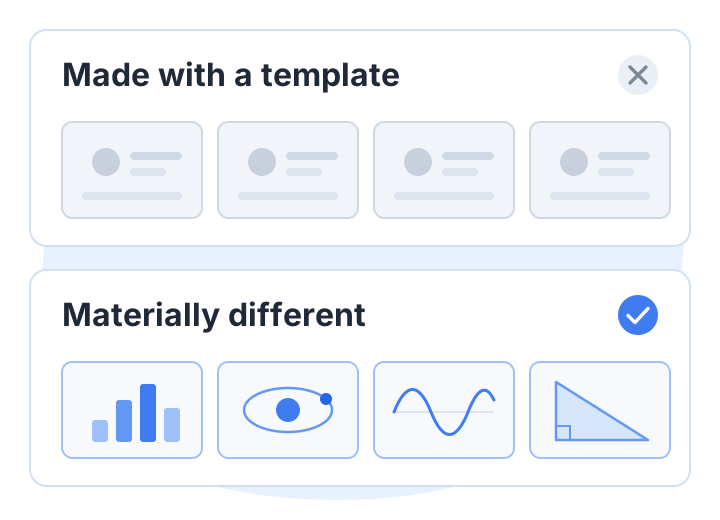
The same page also gives examples of what is allowed. Using the same intro and outro is fine if the bulk of each video is different. A series is fine too, such as one that follows the same characters, or a product review channel, as long as each video has its own storyline, focus or idea. YouTube’s test is that the substance of each video should be materially different and give the viewer creative, educational or other value.
2. Reused content
Reused content means taking material that already exists on YouTube or elsewhere and uploading it without significant original commentary, changes or value. This catches many AI “faceless” channels, because a common format is an AI voice reading over clips from films, sports or other creators.
Two details in the policy surprise people:
- Permission does not help. The policy applies even if the original creator said yes.
- It is not about copyright. You can get no copyright claims and still break the reused content policy.
Not allowed includes content that only reads out material you did not create, such as text from websites or news feeds. That example sat under the inauthentic content policy before July 2026 and now sits here. Either way, an AI voice reading a scraped article cannot monetize.
Content that is allowed includes a critical review using clips, a sports replay where you explain the moves, and a reaction where you actually comment. The common thread is that a viewer can see a real difference between the original and your video.
3. Unsatisfying or off-putting content (new)
This section was added in July 2026. It covers content that relies heavily on emotionally manipulative formulas, copies existing formats or stories so closely that videos feel interchangeable, or seems designed to shock or surprise viewers only to get views.
YouTube’s examples of what cannot monetize include:
- Content that keeps using disturbing themes, such as violence or loss, without building a proper story
- Channels built on generic templates or emotional manipulation, such as a series of repeated scenes of animals in exaggerated distress or danger
- Videos with no clear story or logical order, such as unrelated AI clips stitched together to surprise or shock viewers
- Realistic visuals that trick viewers, for example into believing a fake celebrity death or natural disaster has happened
This section is also where YouTube is clearest that AI is allowed. It says that if you use automated tools or templates, the final video must still show your creative vision and give educational or entertainment value. Its allowed examples include using AI to visualize a character and story you invented, and using AI to edit your scripts or create a background visual.
4. AI personas on sensitive topics (new)
This section was also added in July 2026, and it is the only one about a specific AI format. Channels that use AI-generated personas to give information on sensitive topics will not be allowed to monetize. YouTube says this includes any content that presents itself as a human expert giving advice on topics such as health, legal issues, finances or politics.
YouTube’s examples:
- An AI “doctor” giving medical diagnoses, health advice or wellness remedies
- AI-generated podcast hosts giving financial guidance, investment tips or wealth management advice
- AI personas giving legal advice or explaining laws
In India this hits a popular format directly: AI avatar channels giving stock tips, tax advice or home remedies. The policy does not say that a disclosure label makes such a channel eligible. If you teach money, health or law, the safe route is to appear as yourself.
Your whole channel is judged
These policies are written about channels, not single videos. The reused content section says plainly that if you have videos that break it, monetization may be removed from your entire channel.
Reviewers cannot watch every video, so YouTube says they may focus on your channel’s main theme, most viewed videos, newest videos, the videos with the most watch time, your titles, thumbnails and descriptions, and your “About” section. A channel with one good series and 200 bulk-made AI uploads will be judged on the 200.
Rule 2: disclosing realistic AI content
The second rule is about honesty with viewers, not about earning. YouTube introduced it in a March 2024 blog post, and the Help Center page sets out the current version.
What needs disclosure
YouTube requires disclosure when AI is used to make realistic content that:
- Makes a real person appear to say or do something they did not do
- Alters footage of a real event or place
- Generates a realistic scene that did not actually happen
- Creates music that is the main focus of the video (a newer addition to the list)
YouTube’s examples include AI-generated music, AI footage of a real place added to a travel video, a realistic AI video of a match between two real tennis players, making it look as if someone gave advice they never gave, and making it look as if a real person was arrested.
What does not need disclosure
- Clearly unrealistic content, such as fantasy scenes or animation
- Minor edits: beauty filters, color and lighting, background blur
- Production help: using AI for an outline, script, thumbnail, title or infographic
- Captions, upscaling, and voice or audio repair
- Idea generation
- Cloning your own voice for voiceovers or dubs
- Gameplay footage from video games
How to disclose
YouTube says the disclosure is made during upload in YouTube Studio, on a computer or a mobile device. In the Attributes section, under “AI use”, select Yes if the content meets the requirements, or No if it does not.
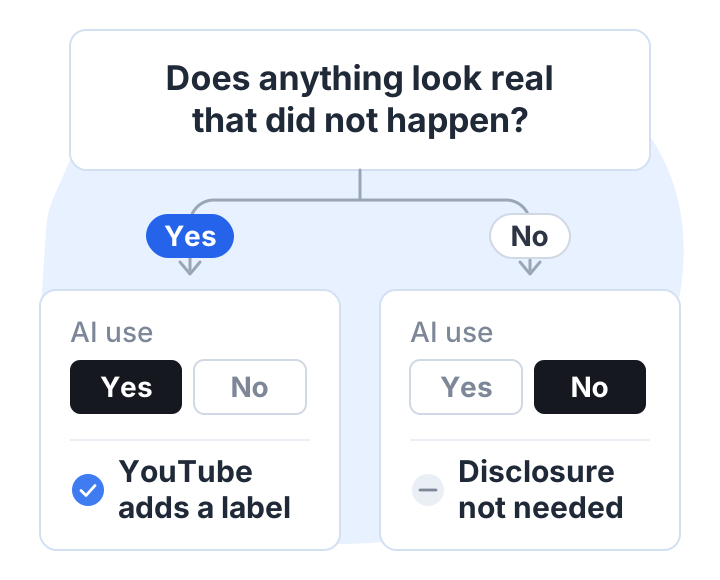
If you select Yes, YouTube adds a label. For AI-generated music or photorealistic content it may appear on the video player; for other AI audio and for non-photorealistic or animated content it may appear in the expanded description.
YouTube can also add a label itself, for content made with its own AI tools, content carrying C2PA metadata, or content its systems detect as AI. You get a notification in YouTube Studio when this happens. If the system got it wrong, you can usually fix it by selecting No under “AI use” in Attributes. Labels on content made with YouTube’s AI tools, content with C2PA metadata, or content labeled after a manual review cannot be changed.
What happens if you do not disclose
YouTube says creators who consistently choose not to disclose may have a label added manually, or face penalties including removal of content or suspension from the YouTube Partner Program.
And the reassurance, in YouTube’s own words: disclosing AI content alone “won’t limit a video’s audience or impact its eligibility to earn money.”
A worked example: three AI channels
All three channels below use AI heavily. Only one is likely to pass review.
Channel A: “Daily facts”. Every day it uploads three videos. Each is an AI voice reading a list of facts scraped from websites, over AI images, in the same template. Titles change; nothing else does.
- Generic or repetitive content: yes. Templated, mass-produced, no perspective of its own.
- Reused content: yes. The policy names videos that only read out text from websites as an example.
- Disclosure: not the main issue. Its problem is monetization, not labels.
Channel B: “Smart money tips”. A realistic AI presenter in a suit introduces himself as a market expert and gives daily stock picks and tax-saving tips. The scripts are original and every video is different.
- Generic or repetitive content: maybe not. Each video covers new stocks.
- AI personas on sensitive topics: yes. This is close to YouTube’s own example of AI hosts giving investment tips. The channel cannot monetize, however good the scripts are.
- Disclosure: likely needed too, because the presenter looks like a real person.
Channel C: “Physics for Class 11, in Hindi”. A teacher writes each script herself, using AI to tidy the wording. She records her own voice, then uses AI to generate animated diagrams of each concept. Every video explains a different topic in her own words.
- Generic or repetitive content: no. Each video is materially different and educational.
- Reused content: no. The explanation is hers.
- Unsatisfying or off-putting: no. Each video follows a clear, logical order.
- AI personas: no. She is a real person speaking as herself.
- Disclosure: not needed. Animated diagrams are not realistic, and AI script help is production assistance.
Channel C uses AI as much as the other two. The difference is that every video still carries a real person’s knowledge and judgment, and that person is the one speaking. That is the line YouTube draws.
A quick check before you upload
- Would a viewer notice if you swapped this video with the last one? If not, it may count as generic or repetitive.
- Is any part copied from somewhere else? If so, what did you add that a viewer can see?
- Is the video built mainly to shock, or does it tell a clear story? Shock with no story is now its own policy.
- Is an AI character giving health, money, legal or political advice? If so, the channel cannot monetize. Present it yourself.
- Does anything look real that did not happen? If yes, set “AI use” to Yes.
- Would you be happy if a reviewer opened your 10 newest videos? That is roughly what happens.
These policies decide whether a channel can earn; the Partner Program thresholds decide when you can apply, and both change in 2027. Our guide to the monetization rules has the current numbers and the new ones. For ideas that are easy to keep original, see our list of YouTube channel ideas.
Another way to earn: sell a course
YouTube’s policies keep coming back to one thing: your own knowledge, delivered by you. That is also what people pay for in a course, and no policy review decides whether you can sell one. Courselink imports your YouTube playlist as lessons in order, and students pay into your own Stripe or Razorpay account with 0% taken by Courselink. You can build the course free, but the Free plan cannot sell — paid courses start on Lite at $19 a month (₹1,499), and your own domain on Standard. See pricing for each plan.
More ways to earn below the thresholds are in how to make money on YouTube without monetization.
Sources
- YouTube channel monetization policies: original and authentic content; generic or repetitive content; reused content; unsatisfying or off-putting content; AI personas related to sensitive topics; and how reviewers check a channel. Compared against the version before the July 2026 rewrite.
- Disclosing use of GenAI content: what needs disclosure, how to disclose, labels and penalties.
- How we’re helping creators disclose altered or synthetic content, YouTube Official Blog, March 2024.
- YouTube Partner Program overview and eligibility and Changes to the YouTube Partner Program: the February 1, 2027 thresholds and the January 31, 2027 terms deadline.
YouTube updates these policies without much notice. The July 2026 rewrite appeared on the Help Center page without a dated note at the top. Before you rely on any line here, open the policy page and read the current version.