

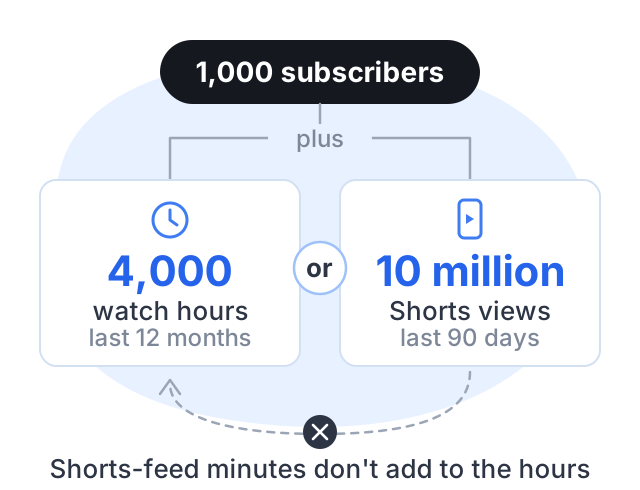
You can start earning on YouTube at 500 subscribers, but only from fan funding features like memberships and Super Thanks. Ad revenue needs 1,000 subscribers plus either 4,000 watch hours or 10 million Shorts views. Both numbers come from YouTube’s own help pages and are set out in full below.
To see how close your own channel is, use our eligibility check. If you are stuck under one of those numbers, skip to what to do if you do not qualify yet.
The two thresholds
YouTube runs the Partner Program in two tiers. The lower one lets your audience pay you directly. The higher one adds a share of ad revenue.
| Fan funding tier | Ad revenue tier | |
|---|---|---|
| Subscribers | 500 | 1,000 |
| Public uploads | 3 valid, in the last 90 days | Not stated |
| Either watch hours | 3,000 qualified, last 12 months | 4,000 qualified, last 12 months |
| Or Shorts views | 3 million qualified, last 90 days | 10 million qualified public, last 90 days |
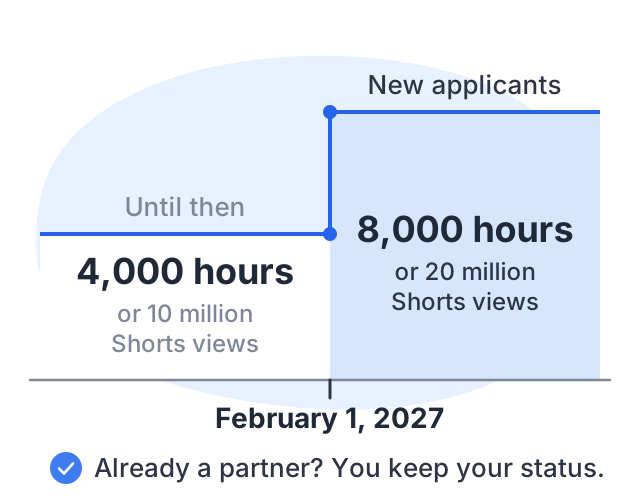
The ad revenue column changes on February 1, 2027, and the fan funding column does not. The new figures are below.
Read the watch hours and Shorts views rows as alternatives: you need one or the other, not both. Watch time from the Shorts feed does not count toward the 4,000-hour figure, so a channel that grew on Shorts has to clear the Shorts bar rather than the watch-hours one.
What each tier actually unlocks
At 500 subscribers, joining the expanded Partner Program gives you channel memberships, Super Chat and Super Stickers, Super Thanks, jewels and gifts, and YouTube Shopping. Each of those has its own requirements on top, and you have to review and accept the Commerce Products Module before any of them turn on.
At 1,000 subscribers, you add revenue sharing from ads and from YouTube Premium. This is the one most people mean by “monetization”, and it is the one that takes longest to reach.
Every feature at the lower tier is your own audience paying you. YouTube is not paying you at 500 subscribers; it is letting your viewers pay you, and taking a share for handling it.
The requirements nobody mentions
Subscriber and view counts are the thresholds people talk about. These are the ones that actually block applications:
- You must live in a country or region where the Partner Program is available. YouTube keeps the list on its help site.
- No active Community Guidelines strikes on the channel.
- 2-Step Verification turned on for the Google Account.
- An AdSense for YouTube account linked to the channel, or be ready to set one up in YouTube Studio.
- Access to advanced features on the channel.
- You must follow the YouTube channel monetization policies.
Joining is not automatic once you cross a number. Your channel goes into a review that YouTube says typically takes about a month.
What changes on February 1, 2027
The ad revenue thresholds double for new applicants. From February 1, 2027 it becomes 8,000 qualified watch hours in the last 365 days, or 20 million qualified Shorts views in the last 90 days, still with 1,000 subscribers. The 4,000-hour and 10-million-view figures in the table above apply until then.
If you are already in the Partner Program, nothing changes. YouTube is explicit: your status is not impacted by the update. The old numbers are a door that closes — get in before February 1, 2027 and you keep the terms you joined on.
Fan funding is untouched. The 500-subscriber tier keeps its requirements, as do YouTube Creator Partnerships and Shopping.
Two ongoing requirements also start then. To keep earning from the Shorts Creator Pool each month you need to maintain 10 million qualified Shorts views over the trailing 90 days — it becomes a recurring bar rather than a one-time gate. And a channel counts as active if it meets any one of: 1,000 qualified watch hours in 365 days, 1 million qualified Shorts views in 90 days, or 2 long-form videos or 5 Shorts uploaded every 90 days. Fall below and you get a 90-day window to recover.
Every partner has a deadline too. YouTube asks everyone already in the Partner Program to review and accept the updated terms in YouTube Studio by January 31, 2027. If you do not accept them by then, you stop earning from the features those terms cover until you do. You can accept some modules and not others, but YouTube recommends accepting all of them.
One part of that applies only to older channels: creators who turned on fan funding features before 2023 are on an older Commerce Product Addendum and need to accept the Commerce Product Module, or those features stop earning.
Why your progress can go backwards
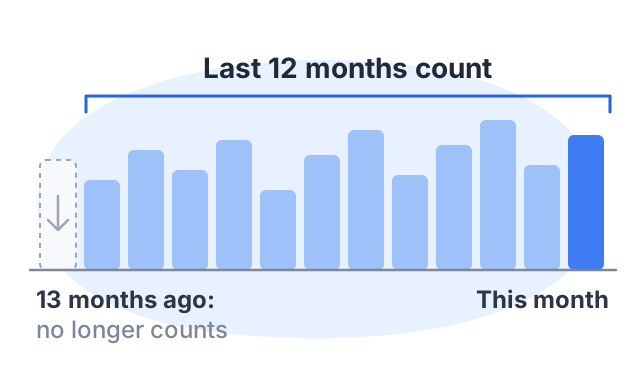
Both watch-hour figures are measured over a window, not over the life of the channel. The 4,000 hours must fall in the last 12 months, and the Shorts views in the last 90 days. Hours you earned 13 months ago no longer count toward the total, which is why a dormant channel can watch its own number fall.
Inactivity can cost you more than progress. YouTube says it may turn off monetization on channels that have not uploaded a video or posted to the Posts tab for 6 months or more, and this applies to channels already in the program.
The practical effect is that the threshold rewards recent activity. A channel that uploaded steadily last year and stopped will drift below the line, while a smaller channel that is posting now climbs toward it. If you are close, the worst thing you can do is pause.
A worked example
Take a channel with 5,000 subscribers and 40,000 views a month — a real teaching channel, not a huge one.
Subscribers are not the problem: 5,000 clears both tiers. The question is watch time. If the average view lasts 4 minutes, 40,000 monthly views is about 2,667 watch hours a month, which clears 4,000 hours in under two months. If the channel is mostly Shorts, those same 40,000 views are nowhere near the 10 million Shorts views the ad tier asks for, and the channel would need the long-form path instead.
At the 2027 figure of 8,000 hours, the same channel needs about three months rather than one and a half. The Shorts route is the harder one either way: ten million views in 90 days is a different order of magnitude from 4,000 watch hours in a year, and many Shorts channels with healthy subscriber counts never reach it.
What to do if you do not qualify yet
The thresholds measure your audience’s size. They do not measure whether anyone would pay you, and those are not the same question. A channel with 800 subscribers who watch every upload is worth more than one with 5,000 who do not.
Three things that do not need YouTube’s approval: sponsorships, affiliate links, and selling something of your own. None has a subscriber threshold, because YouTube is not part of the transaction. Our guide to making money without monetization covers how to start each one.
Another way to earn: sell a course
Courselink turns a playlist you have already published into a paid course site: the lessons import in order, students pay into your own Stripe or Razorpay account, and Courselink takes 0% of every sale. You can build the course free, but the Free plan cannot sell — paid courses start on Lite at $19 a month, and your own domain on Standard. See pricing for each plan.
Sources
Every figure on this page comes from YouTube’s own help pages, as of October 2026:
- YouTube Partner Program overview and eligibility — the 1,000 subscriber tier, watch hours, Shorts views, the account requirements, the inactive channel rule and the January 31, 2027 terms deadline.
- Overview of the expanded YouTube Partner Program — the 500 subscriber tier and the features it unlocks.
- Changes to the YouTube Partner Program — the February 1, 2027 thresholds, the activity rules and the updated terms, including the Commerce Product Module.
YouTube changes these rules more often than most platforms. If you are reading this months later, check the links above before acting on a number.