

You make money selling courses by charging for a clear, step-by-step way to learn one skill, and selling it to people who already trust you. What you keep is the price, minus card fees, minus whatever the platform takes, and that last part ranges from almost nothing to more than half of each sale.
The money comes first below, then how to validate the idea, price it and reach the first 10 buyers.
Where the money goes on each sale
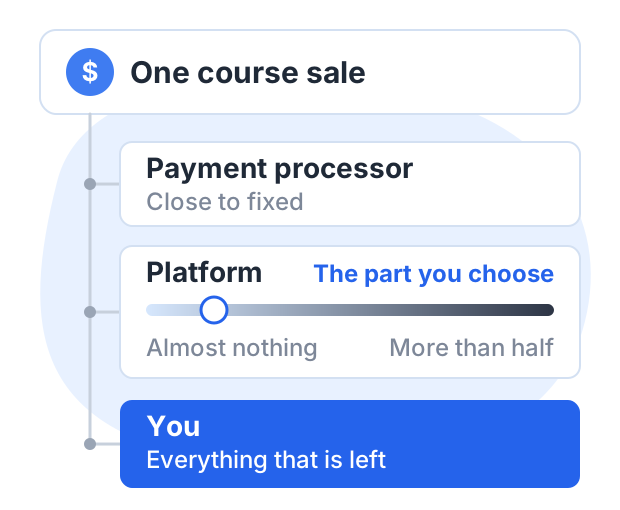
Every course sale is split between up to three parties: you, the payment processor and the platform. The processor fee is close to fixed. The platform’s share is the part you choose.
| Where you sell | What the platform takes | Who finds the buyers |
|---|---|---|
| Udemy, organic sale | You get 37% of the net amount | Udemy |
| Udemy, through your coupon or link | You get 97% of the net amount | You |
| Gumroad, direct sale | 10% + $0.50 per sale | You |
| Gumroad, Discover marketplace | 30% per sale | Gumroad |
| Teachable Starter plan | $39 a month plus a 7.5% transaction fee | You |
| Your own Courselink site | $19 a month on Lite, 0% of sales | You |
On top of the platform’s share, card payments cost money. Stripe’s standard US price is 2.9% + 30¢ for a domestic card, with 1.5% more for an international card and 1% more if currency conversion is needed. Udemy’s percentages apply to the “net amount”, which is after taxes and fees such as the app store fee on mobile sales.
The pattern is simple. A marketplace finds buyers and keeps a large share. Your own site keeps almost nothing, but you find every buyer yourself. Neither is wrong. The question is whether you already have people who would buy.
A worked example
Maya is a bookkeeper. She has a YouTube channel and an email list, together about 3,000 people, mostly small business owners. She makes a course called “Set up QuickBooks for a one-person business” and charges $79.
In the first month, 25 people buy it.
- Gross sales: 25 × $79 = $1,975
- Stripe fees at 2.9% + 30¢: 25 × $2.59 = about $65
Now compare what Maya keeps in three setups, all for the same 25 sales:
| Setup | Platform cost | Maya keeps (approx.) |
|---|---|---|
| Courselink Lite | $19 plan | $1,975 − $65 − $19 = $1,891 |
| Teachable Starter | $39 plan + 7.5% ($148) | $1,975 − $65 − $39 − $148 = $1,723 |
| Udemy, sales through her own coupon or link | 3% of net | about 97% of $1,975 = $1,916 or less |
| Udemy, sales Udemy’s marketplace brings | 63% of net | about 37% of $1,975 = $731 or less |
The two Udemy rows are the same 25 sales under different assumptions about who found the buyer, which is the variable that matters there. In Maya’s case she brings the audience herself, so the 97% row is the comparable one; the 37% row is what the same course earns from students Udemy finds. Both are “or less” because Udemy’s percentages apply to the net amount, after taxes and fees.
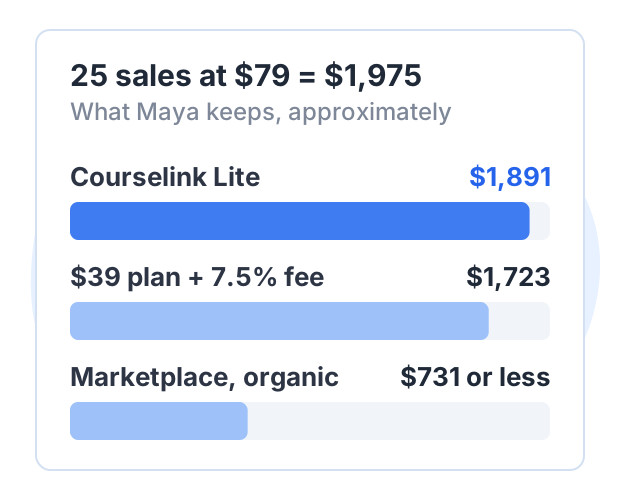
This is arithmetic, not a forecast. The hard number in Maya’s example is the 25 buyers, and that came from an audience she spent years building. A course does not create demand. It turns trust you already have into income.
Step 1: pick one problem for one kind of person
Most first courses fail because they are too broad. “Learn Excel” competes with thousands of free videos. “Excel for restaurant owners who need to track food costs” has a buyer who can picture the result.
Write one sentence: “This course helps [specific person] to [specific result].” If you can’t finish it, the course isn’t ready to plan.
Good places to find the problem:
- Questions people ask you more than once, in comments, emails or calls
- The video of yours that gets the most “how do I…” comments
- The task you already do for paying clients
Our list of online course ideas has three quick tests for an idea.
Step 2: check that people will pay before you build
You don’t need a survey tool. Use what you have:
- Ask directly. Post or email: “I’m making a course on X. Would you buy it at around $Y?” Count the replies that say yes and mean it.
- Look for money already spent. Are people paying for books, coaching or software to solve this problem? Then the problem has a budget.
- Pre-sell, if you can. A small number of people paying before the course exists is stronger proof than any number of likes.
Step 3: make the course small and complete
A first course does not need 40 hours of video. It needs to take someone from the problem to the result with no gaps, which for most topics is 5 to 20 short lessons, one per step, in the order the student would do them. Our course outline template gives you a fill-in structure, and a mini course of 3 to 7 lessons is a smaller first step if you want to test the idea before building the whole thing.
Step 4: set a price you can explain
Price on the result, not on the number of hours. A course that saves a business owner a $500 bookkeeping bill can charge more than a course with twice the video about a hobby.
Ask what the buyer would pay to solve this problem another way: a tutor, a consultant, a book plus a lot of trial and error. Your course should cost less than the expensive option and give more than the cheap one. Our guide to online course pricing works through this in detail.
Step 5: write a sales page that answers the buyer’s questions
A sales page helps the right person decide yes and the wrong person decide no: who the course is for, what they will be able to do, what is inside, who you are, and what it costs. The course sales page guide covers each section.
Step 6: get your first 10 buyers
The first 10 buyers almost always come from people who already know you. Here is the order that tends to work:
-
Tell your existing audience, more than once. One post is easy to miss. Announce it, share a lesson from it, then remind people before any launch price ends.
-
Write to people one by one. Past clients, people who asked you this exact question, colleagues. A personal note is much harder to ignore than a broadcast. Something like:
Hi Sam — you asked me last year how to stop the VAT quarter being a scramble. I’ve put the whole setup into a short course, 12 lessons, about 90 minutes. It’s $79 and it’s open now: [link]. Happy to answer anything before you decide.
Three sentences: the problem they told you about, what you made, what it costs and where. Keep a list of who you wrote to, the date, and what they replied — a spreadsheet with four columns is enough. After ten of these you can see which sentence gets answers, and whether the people who say “not now” are saying it for the same reason.
-
Give a real preview. Let people watch one or two lessons free. It shows how you teach better than any description.
-
Offer a launch price with a real end date. A coupon for the first buyers, which expires when you said it would.
-
Ask the first buyers for honest feedback. Fix what confuses them. Their words, with permission, become your first testimonials.
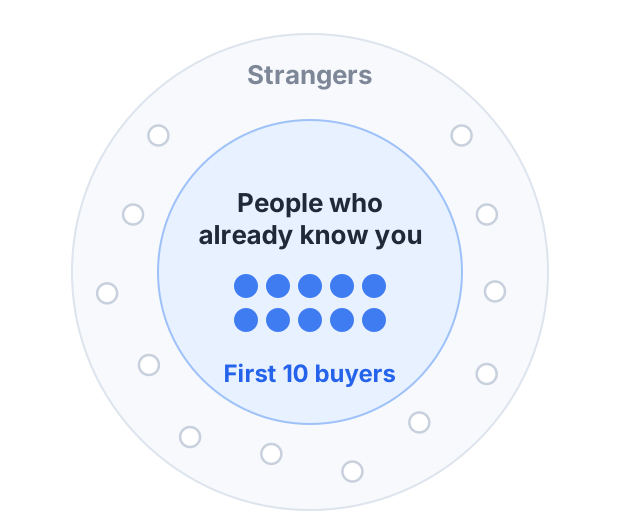
After the first 10, the work changes. You keep making free content that brings new people in, and the course becomes the paid next step for the ones who want a full path.
What makes this work, and what doesn’t
It works when: you teach a skill that saves someone money or time, the audience is specific, and you keep making free content after launch.
It doesn’t work when: the course is a general topic with endless free answers, you launch to nobody, or you stop talking about it a week after release.
Nothing here is a promise. Some courses sell to nobody. The ones that sell are usually narrow, practical and offered to people who already asked for help.
How to do this on Courselink
Courselink is the setup in Maya’s example: your own course site, where students pay into your own Stripe or Razorpay account and Courselink takes 0% of every sale. You can build and publish free courses on the Free plan, but it cannot sell — paid courses, payments, coupons and sales analytics start on Lite at $19 a month, and a custom domain on Standard. See pricing for the full plan table.
Sources
Fees on this page come from each company’s own pages, as they stood when this guide was published:
- Stripe pricing: 2.9% + 30¢ per successful domestic card transaction, +1.5% for international cards, +1% for currency conversion
- Udemy instructor revenue share: 97% through instructor coupons or referral links, 37% otherwise, on the net amount
- Gumroad pricing: 10% + $0.50 on direct sales, 30% on Discover sales
- Teachable pricing: Starter at $39 a month billed monthly, with a 7.5% transaction fee
Vendor prices change often. Check the vendor’s own page before you decide. The worked example is arithmetic from a stated price and number of buyers, not an average or a forecast.