

A mini course is a short course that teaches one small skill or solves one problem, usually in 3 to 7 short lessons. To create one, pick a single problem, plan one lesson per step, record or reuse the videos, add one worksheet, and publish it free or at a low price.
If you already make videos, you may have most of one already. This guide shows how to build it from the videos you have, and how to decide whether to sell it or give it away.
What a mini course is not
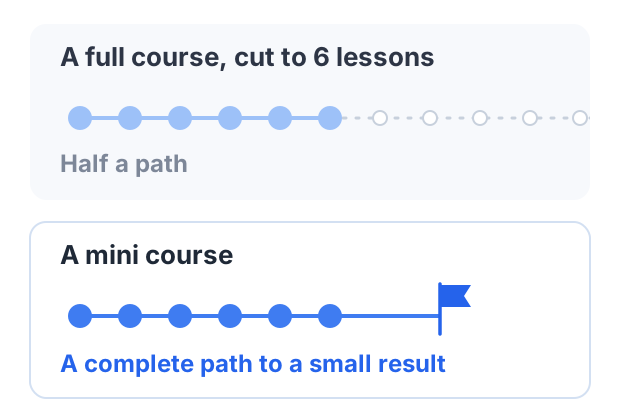
It is not a trimmed-down full course. Cut a 30-lesson course to 6 lessons and the student gets half a path; a good mini course is a complete path to a small result — “take sharp photos of your products on a phone”, not “learn photography”.
Why make a mini course first
A mini course is a smaller bet than a full course:
- Less to make. A few lessons instead of dozens.
- Faster feedback. You learn what students struggle with before you build something big.
- An easier first yes. A short course at a small price, or free, is a low-risk way for someone to try how you teach.
- A step toward a larger course. Students who finish a mini course are the people most likely to want the full version.
The trade-off: a mini course earns less per sale. Its job is often to start a relationship, not to be your main income.
Step 1: choose one small problem
Look for a problem that is small, specific and often asked about:
- A question you answer again and again in comments or emails
- A step in your bigger topic where beginners get stuck
- A task that takes your audience hours but takes you minutes
Write it as one sentence: “After this mini course, you will be able to [one result].” If the sentence needs “and”, the topic is probably two mini courses.
Step 2: plan the lessons
Use this five-lesson outline as a starting point:
| Lesson | Job | Example: pricing freelance work |
|---|---|---|
| 1. The goal | Show the result and why it matters | What a well-priced project looks like |
| 2. The first step | The easiest win | Work out your real hourly cost |
| 3. The core method | The main skill | Price by project, not by hour |
| 4. Common mistakes | Save them from the usual errors | Discounting too early, vague scope |
| 5. Do it now | A task they finish before closing the course | Price one real project with the worksheet |
Each lesson does one job. If a lesson does two jobs, split it. If a lesson does no job, cut it.
Step 3: reuse the videos you already have
If you have a YouTube channel, look through it for videos on the problem you chose. You often find several that cover parts of it, in no particular order. That is your raw material.
For each video, ask:
- Does it match one lesson in the outline? Keep it.
- Does it cover two lessons? Use it for one and note what is missing for the other.
- Is it off topic or out of date? Leave it out.
Then record short new videos only for the gaps. Often that means an introduction that sets the goal, and a final lesson that tells the student exactly what to do next.
The free videos stay public. What the mini course adds is the order, the missing pieces and the worksheet.
Step 4: add one thing free videos don’t have
A mini course needs something that makes it more than a playlist. One item is enough:
- A worksheet or template the student fills in during lesson 5
- A checklist to use after the course
- A short quiz that checks they understood the core method
Pick the one that helps the student reach the result. Don’t add extras just to look bigger.
Step 5: decide free or paid
| Free mini course | Paid mini course | |
|---|---|---|
| Goal | Show how you teach; build a list of students | Earn from a small first purchase |
| Who it attracts | Anyone curious | People ready to pay |
| What happens next | Some students buy your full course later | Some buyers move up to your full course |
| Risk | You give work away | Some people won’t pay for a short course |
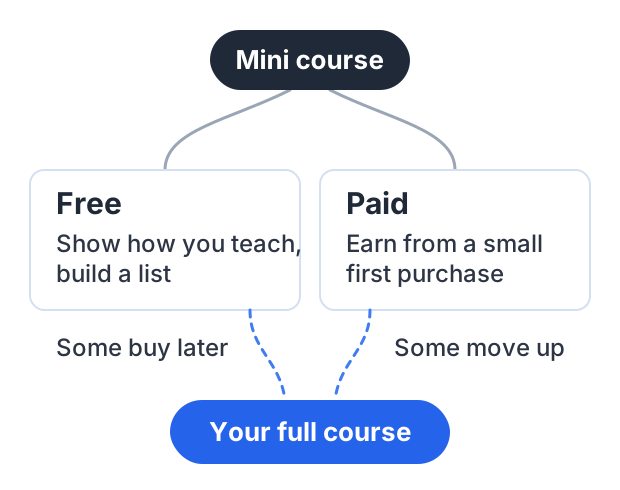
There is no single right answer. One approach is to start free, see how many people finish, and then decide. If you plan a full course later, a free mini course is a natural first step. If you want income now, charge a small price.
A worked example
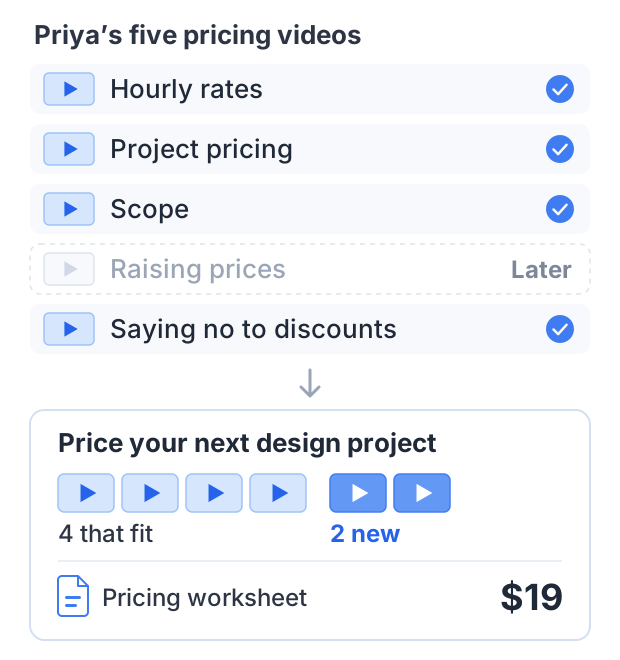
Priya is a freelance designer with a YouTube channel. She has five videos on pricing: one about hourly rates, one about project pricing, one about scope, one about raising prices and one about saying no to discounts.
- She chooses one problem: “Price your next design project with confidence.”
- She maps her videos to the outline. Four fit. The raising-prices video is a different topic, so she saves it for later.
- She records two short new videos: an introduction and a final lesson where students price a real project.
- She adds a pricing worksheet as a PDF.
- She charges $19.
At $19, Stripe’s standard US fee of 2.9% + 30¢ leaves her about $18.15 a sale before her plan cost. The number of buyers is the part nobody can predict; what the mini course reliably gives her is a list of people who finished it, and they are the first she tells about her full course on running a design business.
Common mistakes
- Too broad. “Freelancing basics” in five lessons will feel thin. “Price your next project” will feel complete.
- Filler lessons. A lesson that only says “welcome” wastes the student’s first minutes. Put the goal and the first useful idea in lesson 1.
- No next step. End by telling the student what to do now, and what to learn next if they want more.
- Waiting for perfect. A mini course is meant to be small. Publish it, watch where students get stuck, and improve it.
How to do this on Courselink
Courselink fits the “build from videos you have” approach: paste your YouTube links and the lessons import in order, with the worksheet as a PDF and a quiz if you want one. A free mini course works on the Free plan, which allows 2 free courses and 100 students with no card; charging for it starts on Lite at $19 a month, since the Free plan cannot sell. Courselink takes 0% of your sales on every plan. For help setting the number, read our guide to online course pricing, or see the plan table on pricing.
Sources
- Stripe pricing: 2.9% + 30¢ per successful domestic card transaction in the US
The worked example is arithmetic from a stated price and an assumed number of buyers. It is not an average or a forecast.