

Online course ideas that sell are rarely clever. They are practical skills that one clear group of people needs, such as a trade, a piece of software, a hobby or a life admin task, taught by someone who has done it.
Below are 40 ideas across eight areas, each with the buyer who usually wants it. After the list: how to find an idea of your own, how to screen it, and how to test whether anyone will pay.
40 online course ideas, by area
Each idea is a starting point, and the note after it says who usually buys it. A course gets easier to sell when you narrow it to one of those buyers.
Work and career skills
- Excel or Google Sheets for a specific job — office managers, analysts, small-business owners.
- Writing clear work emails and reports — new managers and people working in a second language.
- Interview preparation for one field — nurses, software testers, teachers changing schools.
- Project management basics — people who were just handed their first project.
- Public speaking for meetings — anyone who has to present to a team.
Money and small business
- Bookkeeping for freelancers — designers, writers and developers working for themselves.
- Pricing your services — new coaches, consultants and trades people.
- Starting an online store — makers who already sell at markets.
- Personal budgeting for one life stage — new parents, recent graduates, people near retirement.
- Writing a simple business plan — people applying for a small loan.
Creative skills
- Phone photography — small shops that need product photos.
- Video editing in one free app — new YouTubers and church media teams.
- Watercolor, sketching or calligraphy for beginners — adults coming back to art.
- Songwriting or one instrument — adult beginners with little time.
- Graphic design for social media — small-business owners who do their own posts.
Technology
- One no-code tool, start to finish — people who want to build a simple app or website.
- Spreadsheet automation — anyone who copies the same data every week.
- Basic cybersecurity at home — families and older adults.
- Building a simple website — local businesses with no web presence.
- Using one design or office tool well — teams that just switched software.
Health and fitness
- Strength training at home — busy parents and people over 50.
- Running your first 5K — complete beginners.
- Yoga or mobility for one need — desk workers, climbers, new mothers.
- Meal planning on a budget — families and students.
- Sleep and daily routines — shift workers.
Note: health topics come with a duty of care. Teach what you are qualified to teach, and tell students to speak to a doctor where it matters.
Home and life
- Organizing a small home — renters and people who are moving.
- Gardening in a small space — balcony and backyard growers.
- Basic home repairs — first-time home owners.
- Cooking one cuisine — people who want to cook food from their family’s culture.
- Planning a wedding or event on a budget — couples planning it themselves.
Teaching and parenting
- Homeschooling one subject — parents teaching math or reading at home.
- Test preparation — students preparing for one specific exam.
- Teaching a language to your own children — families keeping a heritage language alive.
- Classroom tools for teachers — teachers learning new software.
- Toddler sleep or potty training — first-time parents.
Hobbies
- Chess openings for club players — players who know the rules and want to win more.
- Fishing, hiking or camping skills — beginners before their first trip.
- Knitting, sewing or woodworking projects — hobbyists who want one finished piece.
- Dog training for one problem — owners of a new puppy or a rescue dog.
- Photography for one subject — birds, food, real estate.
If none of those is yours
Start with yourself rather than a list. The ideas that sell are usually things you already know well enough that other people ask you about them. Three questions find most of them: what do people ask me for help with, at work or under your videos; what did I learn the hard way, since anything that took you months can save someone else those months; and what do I do every week that others find hard — cooking for a family on a budget, filing quarterly taxes, editing a podcast. Write down everything, then use the list above to sharpen the angle.
Three screening questions
These three questions screen out ideas that are too wide to sell. They do not prove anyone will pay — that comes after them — but an idea that fails one of them is not ready to test.
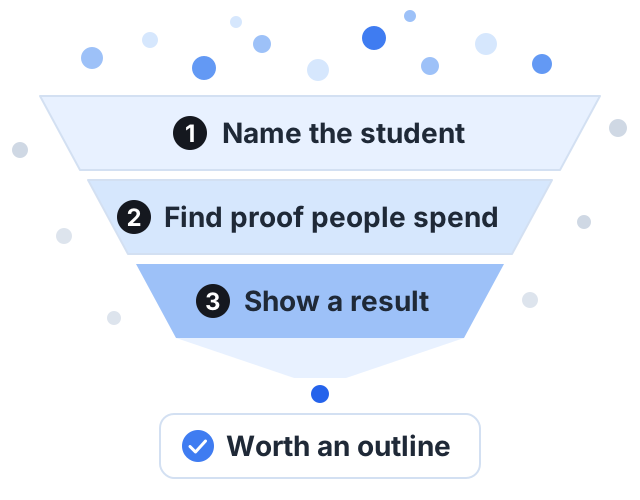
Question 1: can you name the student in one sentence?
“People who want to get better at money” is not a student. “Freelance designers in the US who dread doing their books every quarter” is a student. If you cannot write that sentence, the idea is still too wide.
Question 2: is there proof that people already spend on this problem?
Look for signs that people pay money or time to solve it:
- Books, paid courses or coaches on the same topic. Competition is a good sign. It means buyers exist.
- Questions in forums, Reddit threads and YouTube comments that repeat the same problem.
- Searches. Google Trends can show if interest in a topic is rising or falling. It does not show search volume: Google scales each result from 0 to 100 based on its share of all searches. Use it to compare two topics, not to count buyers.
Question 3: can you show a result?
Students pay for a change. Before you start, write down what a student will be able to do at the end, in words they would use. “Send a clean invoice and close the month’s books in one evening” is a result. “Understand bookkeeping” is not.
The test that actually counts: make an offer
Everything above is circumstantial. People reading about a problem, or buying someone else’s book about it, is not the same as paying you to solve it. The only test that answers that question is an offer.
Write the result in one sentence, name a price, and put it in front of ten people who match your student — individually, not as a post. Then decide in advance what counts as a pass. Something like: “If three of these ten pay a $25 deposit for founding access within a week, I build it.” The specifics matter less than fixing the number before you ask, because afterwards every answer sounds encouraging.
Three responses, and what each tells you:
- They pay. The idea, the student and the price all hold together. Build it.
- They say “that sounds great” and do not pay. Usually the problem is real but not urgent, or the price is wrong for this group. Ask which.
- They ask what it covers and then go quiet. The result you promised is probably not the result they want. That is worth more than a sale — go back to question 3.
If an idea passes the questions and the offer, it is worth an outline. Our guide on how to create a course outline takes it from there.
Worked example: from a vague idea to a course you can sell
Maya is a bookkeeper, and an invented example.
Starting idea: “A course about bookkeeping.”
Question 1, name the student. Maya looks at who actually asks her for help. Most are freelance designers she has met through friends. She rewrites the idea: “Bookkeeping for freelance designers in the US.”
Question 2, look for proof. She finds books and long YouTube videos on freelance bookkeeping, and the same questions come up again and again in a designers’ forum: “What can I deduct?” and “How do I track what clients owe me?” People clearly want help.
Question 3, write the result. “By the end, you will close your month’s books in one evening and know what to hand your tax preparer.” Short, clear, and something a student can check for themselves.
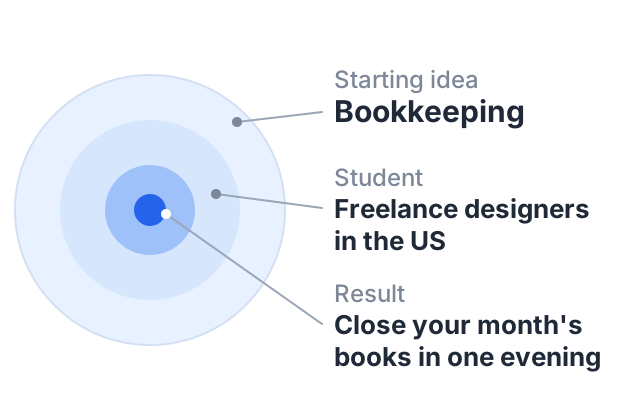
Final idea: a short course with five sections: setting up your accounts, invoicing, tracking expenses, the monthly close, and preparing for tax season.
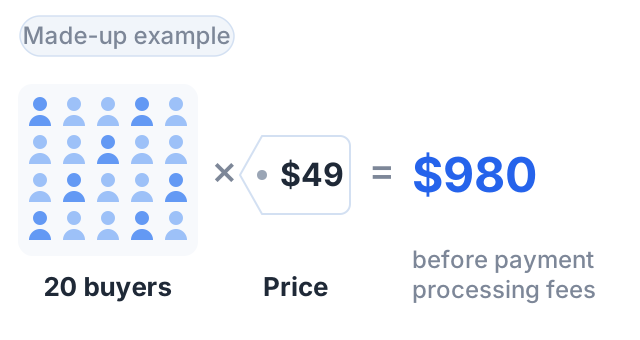
What would make it worth her time. At $49, twenty buyers in the first month would be $980 before payment processing fees. That is arithmetic, not evidence: it sets the target her offer has to test, nothing more.
The offer. Maya messages ten designers from the forum with the one-sentence result and a $49 founding price, and decides beforehand that three payments means build. Whatever comes back, she has learned it in a week rather than after recording twenty lessons.
Notice what changed along the way. The topic did not. The student and the result did, and that is what made the idea sellable.
Mistakes that kill good ideas
- Going too wide. “Photography” competes with everything. “Product photos with your phone for Etsy sellers” competes with very little.
- Teaching what you think people need. Teach what they ask for. You can add the rest later.
- Building for months before anyone sees it. Share the outline, a free lesson or a short video first, and watch the reaction.
- Copying a big creator’s topic. Use your own experience. Your story is the one thing a competitor cannot copy.
How to do this on Courselink
The Free plan lets you build up to 2 courses for 100 students with no card, which makes it a cheap way to put a free mini course in front of people and see who signs up. It cannot sell, so taking payment — including a founding-student deposit — starts on Lite at $19 a month, with coupons for a founding price; a custom domain starts on Standard. Courselink takes 0% of every sale on every plan. See the pricing page, or read more about the free course builder.
Sources
- Google Trends help: how Trends data is adjusted — Trends shows relative interest on a 0 to 100 scale, not search volume.
- Courselink plan details come from our own pricing page.
The $49 price and 20 buyers in the worked example are made up to show the arithmetic. They are not an average or a prediction.