

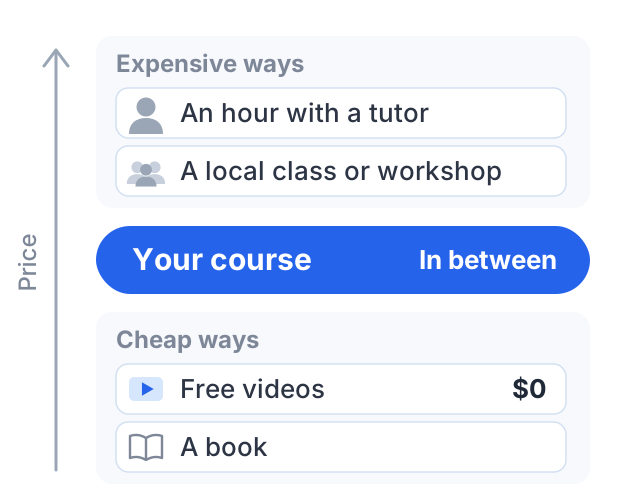
Price an online course on the result it delivers, not on how many hours of video it has. A good first price sits between the cheap way to solve the problem, like free videos or a book, and the expensive way, like a tutor or consultant.
Then treat the first price as a test. Sell to your first group of buyers, watch what happens, and adjust. The rest of this guide shows how to choose that first number, what you keep after fees, and when to change it.
Three ways to find a starting price
Buyers are paying for a result, not for hours: a two-hour course that wins a freelancer one extra client can be worth more than a ten-hour one that does not. So start from the buyer’s side — what problem does the course solve, and what is that problem costing them? — and use all three methods below. If they point to similar numbers, you have a price worth testing.
1. The value method
Write down what the result is worth to the buyer in money or time.
- A course that helps a small business stop paying a bookkeeper $200 a month has a money value you can name.
- A course that saves a designer five hours a week has a time value they can convert into money themselves.
- A course someone takes for enjoyment has a value that is real but harder to put a figure on, so the alternatives method below usually tells you more about its price.
Your price should be a small part of that value, but the calculation alone does not set the price. A result worth $2,000 a year makes $150 arguable, not proven. What supports it is evidence: buyers who have paid that kind of money for the same outcome before, a past client who says the problem cost them a specific amount, or a first group who buy at $150 without asking for a discount. If the only thing behind the number is the multiplication, treat it as a hypothesis and test it.
2. The alternatives method
List what the buyer could do instead, with the real price of each:
- Free YouTube videos: $0, but no order and no support
- A book on the topic: the price on the cover
- A local class or workshop: what it actually costs near you
- One hour with a tutor or consultant: their actual rate
Your course should cost less than the expensive options and give more than the cheap ones. If one hour with an expert costs $150, a course that teaches the same thing step by step can often sit below that and still feel like good value.
3. The comparison method
Look at real courses on the same topic. Open their sales pages and write down the price, what is included and how long the course is. Don’t copy the price. Use it to see where you fit. If yours is more specific, has better support or comes from someone the buyer already trusts, it can cost more.
What you actually keep at each price
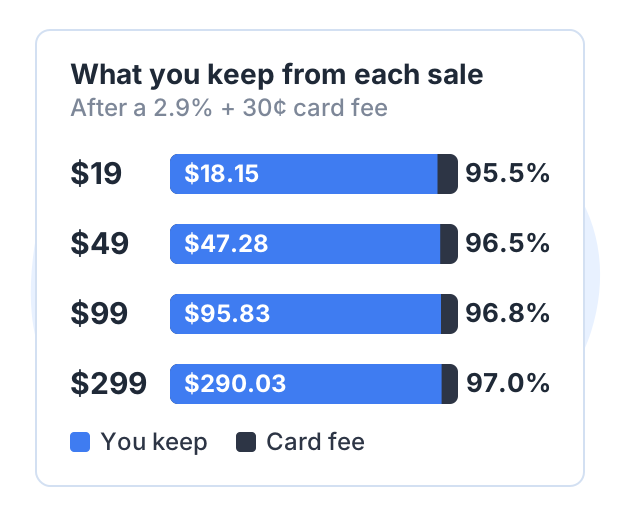
Card fees are a fixed part of every sale. Stripe’s standard US price is 2.9% + 30¢ per domestic card payment. The 30¢ matters more at low prices.
| Course price | Stripe fee (domestic card) | You keep | Share you keep |
|---|---|---|---|
| $19 | $0.85 | $18.15 | 95.5% |
| $49 | $1.72 | $47.28 | 96.5% |
| $99 | $3.17 | $95.83 | 96.8% |
| $299 | $8.97 | $290.03 | 97.0% |
International cards cost 1.5% more, and currency conversion costs 1% more. If many of your buyers are outside the US, take that into account.
This table assumes the platform takes 0% of the sale. If your platform takes a share, subtract it too. On a marketplace like Udemy, the instructor gets 37% of organic sales, so the price you set and the money you receive are very different numbers.
A worked example: $49 or $149?
Sam teaches freelance designers how to write proposals that win clients. Sam has an email list of 2,000 designers and wants $3,000 in gross sales from the first launch — gross, because fees and costs come out of it afterwards.
At $49: Sam needs 62 buyers (62 × $49 = $3,038). That is 3.1% of the list.
At $149: Sam needs 21 buyers (21 × $149 = $3,129). That is about 1% of the list.
What Sam takes home is lower. At 2.9% + 30¢ a sale, card fees come to about $107 on the 62 sales at $49 and about $97 on the 21 sales at $149, so the same $3,038 and $3,129 of sales are roughly $2,931 and $3,032 — before a month of a course platform at $19 or more, and before anything Sam spent making the course. If the goal is $3,000 in the bank rather than through the checkout, add 3 to 4% plus the plan fee to the buyer counts above.
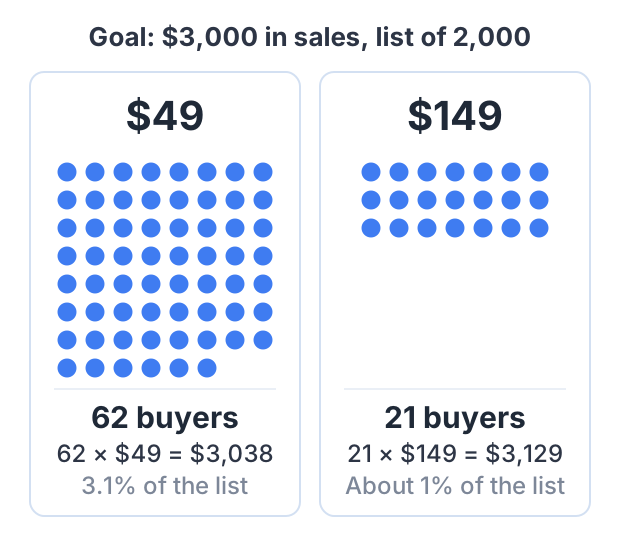
Neither number is a forecast. But the comparison shows something useful. At $149, Sam needs one third as many buyers, and has one third as many students asking questions. At $49, the course is an easier yes, but Sam must reach far more people to earn the same amount.
Sam’s choice depends on the value, and on what the first buyers do with the number. One extra client is worth well over $149 to most freelance designers, which makes $149 a price Sam can explain; whether designers on this list agree is what the launch finds out. If the course only covered proposal templates, $49 would fit better.
To run this on your own numbers rather than Sam’s, the course pricing calculator does the same arithmetic: your audience, the share of it you think will buy, and a price, less the payment fee and a month of a plan.
A useful check: could you say the price out loud to a buyer, and explain it in one sentence? “It costs $149 because one extra client pays for it many times over” passes. “It costs $149 because it has 12 hours of video” does not.
Price endings, tiers and discounts
Price endings
A 2003 study by Eric Anderson and Duncan Simester ran three field experiments in retail catalogs. Prices ending in 9 raised demand in all three. That suggests $49 may sell a little better than $50. But the products were not courses, so test it rather than assume it.
Tiers
You can offer two versions of the same course:
- Course only: the lessons, worksheets and quizzes
- Course plus help: the same, plus something that takes your time, like a feedback call or a review of the student’s work
The higher tier must include something real. A tier that only adds a “bonus PDF” makes buyers suspicious of both prices.
Launch discounts
A launch discount for your first buyers is fair if it is honest. Set a real end date and keep to it. A “discount” that never ends trains your audience to wait. When you raise the price later, keep it the same for people who already bought.
When to raise your price
Raise the price when something real has changed:
- You have proof. Real students got real results and said so in their own words.
- You added value. New lessons, feedback, templates or updated material.
- Demand is steady. People keep buying at the current price, without a discount.
Do not raise it just because a competitor did. Change price in clear steps, announce it in advance, and keep your existing students on what they paid.
Refunds belong in the price decision
A clear refund policy makes the price easier to accept. It also protects you. Stripe’s advice on preventing disputes is to describe your refund policy clearly in your terms and show it before the customer pays. Decide your policy before launch, for example a full refund within 14 days, and put it on the sales page next to the price.
How to do this on Courselink
Paid courses, a discounted price alongside the regular one, free preview lessons and percentage or flat coupons with start and end dates all start on Lite, at $19 a month; the Free plan cannot sell. Courselink takes 0% of your sales on every plan, so the “You keep” column above is close to what reaches you. See the full plan table on pricing, and our guide to making money selling courses for the steps around the price.
Sources
- Stripe pricing: 2.9% + 30¢ per successful domestic card transaction, +1.5% for international cards, +1% if currency conversion is required
- Stripe: how to prevent disputes: include a clear refund policy and show it before purchase
- Udemy instructor revenue share: 37% for sales without an instructor coupon or link
- Anderson, E. and Simester, D. (2003), “Effects of $9 price endings on retail sales: evidence from field experiments”, Quantitative Marketing and Economics
The fee table is arithmetic from Stripe’s published US rate. The worked example uses stated prices and stated buyer counts. It is not an average or a forecast.