

A skill earns money when somebody who has money has a problem it solves. That is the whole test, and it is why the skill you can already do is almost always worth more than a new one you would spend six months learning.
Most lists of money-making skills are lists of things to go and learn. This one starts from what you can do now, sorts skills by who buys them, then covers the half most pages skip: how to teach a skill you have.
What makes a skill earn money
Three questions. Use them on every skill below, and on your own.
- Does somebody already pay for this? Not “would people value it” — does money already change hands for it? If freelancers, shops, tutors or agencies charge for it, demand is proven and you only have to take a share.
- Can you show you can do it? A buyer cannot see inside your head. They need something to look at: a file you made, a before and after, a student who passed, a page you built.
- Can you deliver it remotely? A skill you can hand over as a shared file, a recording or a download sells to anyone in the country, not only to people within a bus ride.
A skill that fails question 1 is a hobby until somebody proves otherwise. One that fails question 2 is a claim. One that fails question 3 can still earn well, but the ceiling is your city.
Skills sold as a service to businesses
Here the buyer is a company, a shop or an agency. They have a budget and they decide quickly, so this is where money usually arrives soonest.
Design — logos, social media sets, packaging, pitch decks, Amazon and Flipkart listing images. Bought by small D2C brands, local shops going online, and agencies needing overflow help. First clients come from one niche done visibly: post ten restaurant menus or supplement labels and people in that trade start asking. The ceiling rises when you sell a whole brand identity rather than files.
Writing — product descriptions, blog posts, email copy, case studies, LinkedIn posts for founders. Bought by marketing teams and agencies. First clients come from a few samples plus cold emails to companies whose site copy is obviously weak. Writing tied to sales pays better than writing paid by the word.
Bookkeeping and compliance — books, invoices, GST returns, payroll support. Bought by shops, clinics, small manufacturers and startups who cannot justify a full-time hire. First clients come from somebody who already knows you: one shopkeeper, then their supplier. The ceiling is good because the work repeats every month, which is rarer than it sounds.
Spreadsheets and data — cleaning messy data, building a stock or billing sheet that works, dashboards, basic SQL reporting. Bought by operations teams and owner-run businesses drowning in files named final_v3. First clients come from fixing one person’s sheet and letting them tell others. The ceiling climbs once you move from making sheets to analyzing what they say.
Video editing — YouTube videos, Reels, wedding films, ads. Bought by creators, agencies and brands. First clients come from editing two or three existing videos unasked and sending them to the creator. The ceiling depends on whether you cut clips or shape a story.
Web work — building and maintaining sites on WordPress, Shopify or Webflow, plus speed and bug fixes. Bought by small businesses and agencies. First clients come from a business you already buy from: the gym, the bakery, the coaching center with a broken site. The ceiling is in maintenance retainers, not one-off builds.
Social media management — planning and writing posts, replying to comments, running basic ads. Bought by local businesses and small brands. First clients come from running one account visibly well, often your own. The ceiling is how many accounts one person can hold in their head.
Skills sold directly to people
Here the buyer is an individual spending their own money. Prices per sale are lower, but nobody has to approve you, and these are the skills most likely to turn into teaching.
Tutoring and exam coaching — school subjects, NEET, JEE, UPSC, banking exams, CA foundation. Bought by parents and by adults preparing on their own. First students come from one or two free sessions for people who already know you, then referrals. The ceiling on one-to-one hours is low; it lifts with batches or recordings.
Spoken English and interview preparation — bought by job seekers, call center and hospitality staff, and students. First students come from local WhatsApp groups and short correction videos. The demand is structural rather than fashionable: much white-collar and customer-facing hiring in India is done in English, so the skill is tied to getting paid.
Music — instrument and vocal lessons, music production. Bought by parents and by adults restarting an old hobby. First students come from your existing circle and from playing in public. The ceiling on taught hours is your calendar.
Fitness, yoga and nutrition — bought by individuals, and by small companies for their staff. First clients come from your own or your students’ visible results. Watch the line between coaching and medical advice.
Cooking — regional cuisines, baking, cake decoration, tiffin businesses. Bought by home cooks and by people trying to start a food business. First students come from one dish taught well on video.
Crafts and trades — tailoring, embroidery, mehndi, carpentry, mobile and appliance repair, two-wheeler servicing. Bought by hobbyists and by people who want the trade as income. First students are local; recordings take you beyond your area.
Skills sold as a product
Here you make something once and sell it many times, so your income stops being a function of your hours.
Templates and files — spreadsheets, Notion setups, resume formats, Canva packs, invoice and GST templates, photo presets. Bought by people who want the result without learning the tool, and they sell because a buyer can see exactly what they get.
Written material — ebooks, guides, question banks, checklists. Lower prices, but cheap to make if the knowledge is already written down somewhere.
Courses — the organized version of a skill, taught in order. The widest price range, the most work up front, and the one product that uses a teaching skill rather than a making skill. Our course ideas guide lists more subjects and three questions for screening them.
Products share one weakness: with nobody to show them to, they sell nothing. A product multiplies attention you already have; it does not get you attention.
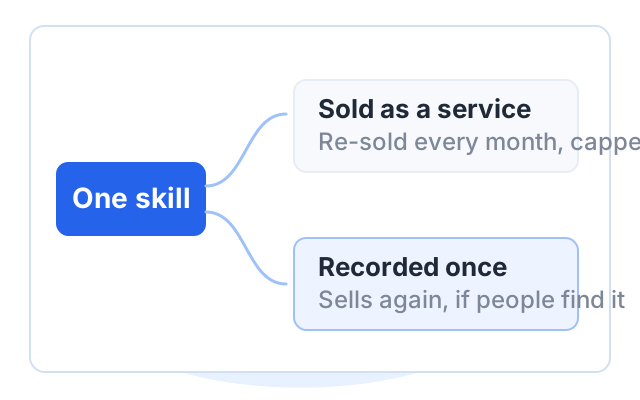
Two ways to earn from the same skill
Any skill above can be sold twice over: you can do the work for someone, or teach them to do it. People treat these as different careers. They are two products from one skill, and the honest comparison looks like this.
| Doing the work | Teaching the skill | |
|---|---|---|
| Who pays | One client, for an outcome | Many learners, for the method |
| Time to first money | Days to weeks | Weeks to months |
| What you earn per hour | Your rate, every time | Nothing while you build, then whatever sales divided by hours spent comes to |
| Does it repeat? | Only if you work again | A recording can sell again with no new teaching hours |
| What limits you | Hours in your week | How many people you can reach |
| Risk | Low: you are paid for work done | Higher: you build first, then find out |
Doing the work wins on certainty. You agree a price, you do the job, you are paid, and it works from your first week with no audience at all.
Teaching wins on repetition, and only on repetition. The first sale of a recorded course costs far more to produce than the first client project; the second sale costs almost nothing. Whether that trade is worth it depends on whether you can reach a second, tenth and fiftieth buyer — marketing work, not teaching work.
So for most people the order is: do the work first, teach it later. Client work pays the bills, proves the skill, and hands you the exact questions your course should be built from. The other guides in our make money with what you know hub follow the same order.
How to teach a skill you already have
This is the half most pages leave out. Here is the sequence, in the order to do it.
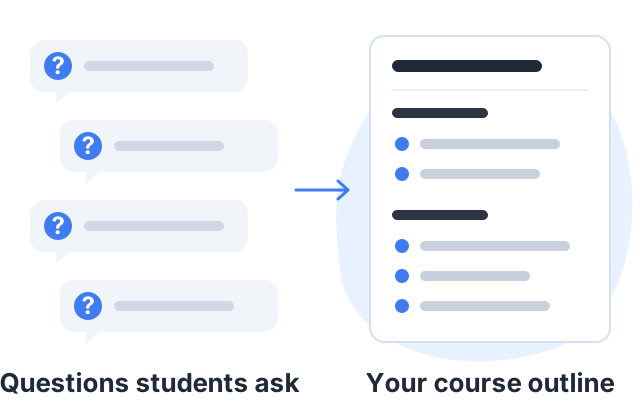
Start from what you are already asked
You do not need to guess what to teach. Open your WhatsApp, your email and your comments and look for the question different people keep asking you. Three separate people asking the same thing beats any keyword tool, because nobody prompted them and they asked you specifically.
Write the questions in their words, not yours. “How do I stop my Excel sheet breaking when I add a row” is a course. “Advanced Excel” is a category.
Choose one outcome, not a syllabus
The most common mistake is teaching everything you know. A buyer is not buying your knowledge; they are buying one change in their situation.
Finish this sentence first: after this course, you will be able to ______. One verb, one result the learner could demonstrate the same week. “Build a billing sheet for your shop that calculates GST automatically” is an outcome. “Master spreadsheets” is not. Everything that does not serve it gets cut, and can be a second course later.
Break it into lessons in teaching order
Imagine one real person next to you and two hours to help them. What do you show first? What do they need before step four makes sense? Where do they get stuck? Write that order down: it is your lesson list. Each lesson does one thing and ends with the learner having done something, not just watched something. A lesson needing more than about ten minutes is probably two lessons.
Then two checks: read the list backwards from the outcome to see what is missing, and cut any lesson that exists because you find it interesting rather than because the learner needs it.
Attach the materials you already have
The files you use in your own work are often worth as much as the video: the template, the checklist, the sample file, the list of common errors. They let a learner reach the result without rebuilding your tools. You almost certainly have them already, and pulling them together costs an afternoon.
Teaching live by the hour, or recording it once
Teaching live pays sooner. One learner pays, you teach, you are paid, and you find out at once which parts of your explanation do not land. The limit is that every rupee needs another hour.
Recording costs the hours up front and pays them back only if enough people buy. The quiet advantage is that teaching live first makes the recording much better: after explaining something to ten people, you know exactly where they get confused.
So teach the same thing live three or four times, keep the notes, then record the version you wish you had given the first group. Our guide to teaching online and earning money compares tutoring platforms, teaching live and selling recordings in more detail.
A worked example: the same skill, two ways
Priya keeps the books for a few small shops and is good with spreadsheets. The same skill, sold both ways:
Sold as service hours. She charges ₹12,000 to set up and clean one shop’s billing sheet, and it takes her about eight hours. Four of those jobs in a month is ₹48,000 for 32 hours, which is ₹1,500 an hour. Next month she starts from zero and needs four more shops.
Taught as a recorded course. She records a two and a half hour course on building that same billing sheet, prices it at ₹1,499, and spends about 20 hours planning, recording and editing it.
Now the assumption, stated plainly: say 25 people buy it in the first month. That is an assumption, not a prediction, and it decides everything below.
- 25 × ₹1,499 = ₹37,475
- Razorpay’s published standard rate is 2% per transaction, plus 18% GST on that fee (razorpay.com/pricing, checked October 2026) — ₹749.50 plus ₹134.91, about ₹884, assuming buyers pay by card. The same page lists UPI at 0% MDR for most transactions, so UPI buyers cost close to nothing
- Courselink Lite at ₹1,499 a month, with 0% taken on sales
- Left: about ₹35,092, for roughly 20 hours of work, or about ₹1,750 an hour
The two look similar in month one. They stop looking similar in month two: the service column is ₹0 until she finds four more shops, while the course column is whatever new buyers arrive, with no new hours from her.
This is arithmetic from stated assumptions, not a forecast. Change the 25 and every line changes. Finding those 25 buyers is your work, and it is the hard part — harder than recording the course. Priya can do it because the shopkeepers she works with know her and talk to each other. With no such audience, the same 25 could take months, or never arrive.
Two honest warnings
No audience means no sales, whatever the skill. This is the most common reason a good course earns nothing: a course page on its own reaches nobody. If you have no list, no following and no referrals, build one of those first, or sell your skill as a service while you do — service work needs only one buyer at a time.
A certificate you issue yourself is not an accredited qualification. A certificate at the end of your course is a record of completion. It is not a government-recognized or university-recognized credential and carries no regulatory weight, so do not describe it as if it does. Send learners who need an accredited qualification to an accredited body: it costs you one sale and earns you a reputation.
Sell a course on Courselink
Teaching the skill once and selling the recording is the version where the hours do not repeat. Courselink is built for that: you add lessons as uploaded video or as YouTube links, organize them into the order you would actually teach in, and sell the course from your own yourname.course.link page. The teachers page shows how this fits a teacher who is already teaching live.
Selling starts on Lite, at $19 a month or ₹1,499 a month, which is where paid courses, Stripe, Razorpay and Sepay, coupons and sales analytics begin. The Free plan is for publishing free courses only — 2 courses for up to 100 students — so it cannot take payments. A custom domain and removing Courselink branding start on Standard. Courselink takes 0% commission on every plan; the payment provider charges its own processing fee. See pricing for what each plan includes.
Sources
- Payment processing fee: Razorpay pricing, checked October 2026 — a 2% standard rate per transaction, with 18% GST applied to that fee. UPI is listed separately at 0% MDR for most transactions, so the worked example assumes the more expensive card case.
- Courselink plan limits and prices are from our own pricing page.
Every other figure here is a price or a quantity chosen as an example and labeled as such. There are no earnings averages, demand rankings or market sizes, because no source we would trust publishes them for these skills in India. What a skill actually earns depends on the buyer you reach, the result you can show, and the price you can explain.