

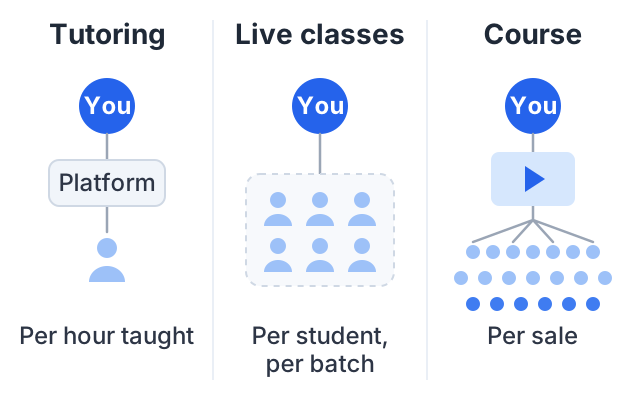
You can teach online and earn money in three main ways: tutoring for a platform, running live classes of your own, or selling a recorded course. Tutoring pays for each hour you teach. A course you record once can be sold many times, so your income is not limited by your hours.
Most people searching for online teaching jobs want the first option, and it is a reasonable way to start. Below: what applying to a tutoring platform actually involves, then when the other two make more sense.
The three ways, side by side
| Tutoring for a platform | Your own live classes | Your own recorded course | |
|---|---|---|---|
| Who finds the students | The platform | You | You |
| Who sets the price | Usually the platform | You | You |
| How you earn | Per hour taught | Per student, per batch | Per sale |
| Time to first income | After you are accepted | As soon as one student pays | After the course is made |
| Limit on income | Your hours | Your hours and batch size | How many people buy |
None of these is the right answer for everyone. The question is what you have today: time, an audience, or a skill people already ask you about.
Option 1: tutoring for a platform
Tutoring and teaching platforms connect teachers with students. You apply, pass their checks, and teach the classes they give you or the students who book you.
Why it is a good start:
- You do not need your own audience. The platform brings the students.
- You learn to teach on camera, with real students, without building anything.
- Payment is handled for you.
What to watch for:
- The platform sets the rules, and often the rate band, the hours and what you teach.
- You earn only when you teach. A week off is a week without income.
- The students belong to the platform, not to you. If you leave, they stay.
Two platforms you can apply to today
Both accept applications from India and neither charges to apply. Checked against each company’s own page in October 2026; terms change, so read the current page before you rely on anything here.
Preply. No certification or teaching experience is required. You need a laptop or desktop, a stable connection, a webcam and a microphone. The application is a profile: basic details, a headshot, a description, a video introduction of up to two minutes, and your availability. Preply says its Tutor Success team reviews profiles within 3 business days, and that profiles can be rejected on a first attempt if the photo, video or description does not meet its requirements. You set your own hourly rate and can change it any time. The commission is the part to read twice: Preply charges commission only on lessons you teach, takes 100% of a trial lesson with a new student, and then charges a commission that starts at 33% and decreases to 18% as you teach more hours on the platform.
italki. You apply through its teacher application, and you need a computer, a headset and an internet connection. italki says teachers set their own prices and hours, and that it handles international payments. Its teacher landing page does not publish the service fee it takes or the qualifications required for each teacher category, so check its teacher policies before you count on a figure.
What to check before you apply anywhere
The rate is the least important number on the page. Check:
- The commission, including on first lessons. A platform that takes all of a trial lesson is paying you nothing to meet each new student.
- Whether the commission falls with hours taught, and how many hours that takes.
- When and how you are paid, and the minimum payout.
- Whether you set your own rate, or choose from a band.
- What happens to a student who wants to continue with you off the platform. Most contracts forbid it; know the rule before you are asked.
- Entry requirements, which differ by subject: language platforms often accept tutors with no certificate, while school-curriculum and exam platforms usually ask for a degree or proof of subject knowledge.
Option 2: your own live classes
Many teachers start here. You choose a subject, set a time, and teach a small group over Zoom or Google Meet. Students pay you directly, often by UPI.
Why it works:
- You keep the whole fee, apart from payment charges.
- One class can teach ten students instead of one, so you earn more per hour.
- You hear students’ questions live. That tells you exactly what a future course must cover.
What is hard:
- You must find the students yourself. Usually that means WhatsApp groups, Instagram, YouTube or word of mouth.
- Collecting payments by hand gets messy as you grow. Who paid, who did not, who joined late?
- Your income is still tied to your hours.
Option 3: your own recorded course
A recorded course is your teaching, organized into modules and lessons that a student watches at their own pace. You make it once and sell it many times.
Why it can earn more for the same teaching time:
- The teaching work is up front. Once the lessons are recorded, a new sale does not need a new hour of teaching.
- Students anywhere can buy it, at any time, in any city.
- You can price it below a live class and still earn well, because you sell it more than once.
What is hard, and what keeps costing you time:
- It takes weeks, not days, to plan and record before the first sale.
- Marketing never stops. A course does not sell itself, and the month you stop talking about it is usually the month sales stop.
- Support continues after the sale. Students email questions, ask for refunds, and get stuck on lesson 4. None of that shows up in the sale price.
- The material goes out of date. A screen that changed, a rule that was amended, a price you quoted: every update is a re-recording.
- Students have no teacher in the room, so lessons must be clear and in a good order the first time.
If you already teach on YouTube, much of this work is done. Your videos can become the lessons, organized into a course for people who want a proper path instead of random videos.
A worked example: a spoken English teacher
These numbers are an example to show the arithmetic, not a promise of earnings.
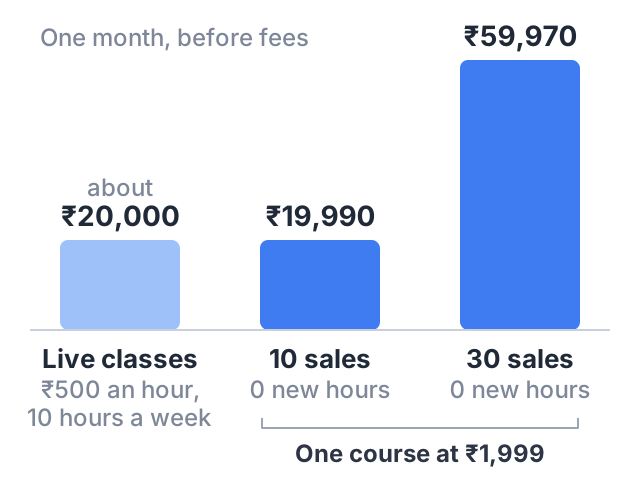
Priya teaches spoken English. She does one-to-one classes and charges ₹500 an hour. She teaches 10 hours a week. That is ₹5,000 a week, about ₹20,000 a month, and it stops the week she stops.
She notices that most students ask the same things: how to introduce yourself in an interview, how to speak on the phone, how to fix common grammar mistakes. So she records a course of 20 short lessons on exactly those topics. She prices it at ₹1,999.
Now the arithmetic changes:
- 10 students buy in a month: ₹19,990.
- 30 students buy in a month: ₹59,970.
- New teaching hours for those sales: none — the lessons are already recorded. That is not the same as no work. Promoting the course, answering student emails and re-recording the two lessons that went out of date are what the month actually costs her, and that work does not shrink when sales grow.
From that she pays the course platform and the payment gateway. On Courselink, the Lite plan is ₹1,499 a month and Courselink takes 0% of each sale. Razorpay charges its own fee on each payment, set out on Razorpay’s pricing page.
Priya does not stop her live classes. She keeps a few hours a week, because live students give her ideas for new lessons, and some of them later buy the course. The course adds income that does not need more hours.
How to choose your first step
Start with tutoring if you have no audience yet. Income depends on being accepted and then booked, so treat the first weeks as an application and a wait, not a salary.
Start with live classes if people already ask you to teach them. Even five students is enough to begin, and a class can run as soon as one of them pays.
Start a recorded course if you notice yourself answering the same questions again and again, or you already have videos on YouTube.
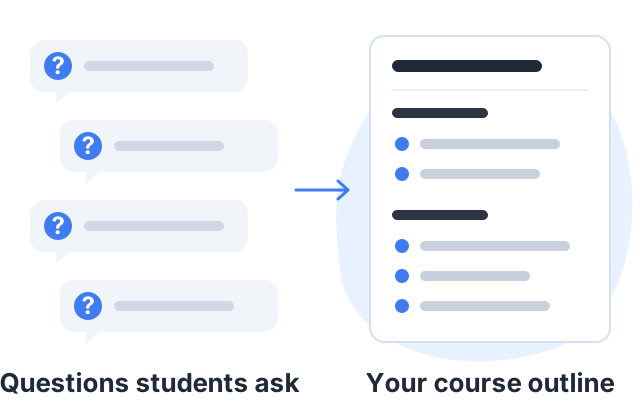
Whichever you choose, write down every question a student asks you. That list becomes your course outline. Our course outline template shows how to turn it into modules and lessons.
Things that help in India
- Teach in the language your students think in. Hindi, Tamil, Malayalam, Bengali, or a mix with English. Many learners prefer a teacher who explains in their own language.
- Make lessons work on a phone. Many students watch on a mobile, so keep each lesson short and focused.
- Price for your students. A course for school students and a course for working professionals need different prices.
- Let students pay by UPI. It is the way many people already pay. Razorpay’s pricing page lists UPI, cards and netbanking among the methods it accepts.
Another way to earn: sell a course
For option 3, Courselink imports your YouTube, Vimeo or Google Drive links as lessons in order, with PDFs, quizzes and certificates. Build free first — the Free plan cannot sell — then paid courses, invite-only courses for a live batch, coupons and Razorpay payments start on Lite at ₹1,499 a month, and your own domain on Standard. Students in India pay in rupees into your own account, and Courselink takes 0% of your sales on every plan. Compare the plans on the pricing page, or start with the free course builder.