

The side income worth starting is the one built on a skill you already have. That is because it removes the learning time, and learning time, not motivation, is what most people with a job or classes actually run out of.
Most lists for this search send you to delivery apps, surveys and dropshipping. Those pay for your hours and stop the moment you stop. This page sorts ideas a different way: by whether the hours you put in keep earning after you have put them in.
Two kinds of side income
Almost every idea falls into one of two groups, and the difference decides how your next year goes.
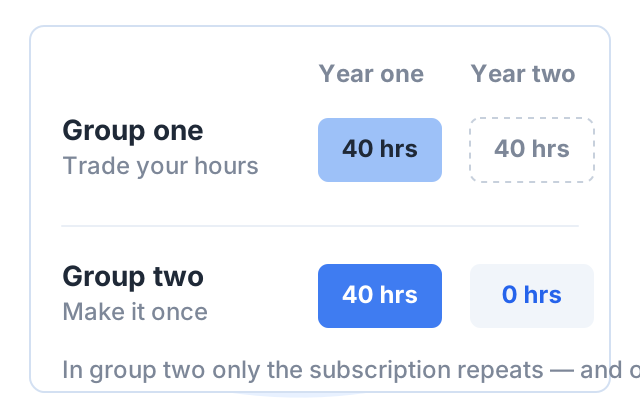
Group one: hours that earn once. Tutoring, freelancing, consulting, a part-time shift, a service gig. You trade an hour and you get paid for that hour. Stop, and the income stops with it.
Group two: hours spent once that can earn again. A recorded course, a template pack, something you write, a digital file, work you license. You spend the hours up front, and a copy can sell later without new hours.
Be fair about both. Group one pays sooner, pays more reliably, and tells you quickly whether anyone wants what you offer. Group two pays nothing at all for a while, and may never pay, because it needs people who have heard of you. Most people who do well at group two paid for it with group one first.
Group one: ideas where hours earn once
Tutoring and test prep
Who it suits: anyone who scored well in a subject recently enough to remember how the exam is marked — board subjects, JEE or NEET sections, CA papers, school maths and science.
What you need first: a quiet place, a stable connection, and a way to write where students can see it, which can be a cheap tablet or a phone camera pointed at paper.
First rupee: after your first student books, which can be within weeks if you ask in groups where parents already talk.
The real work: preparing before each session and chasing payments. Teaching is the easy part; the schedule is what wears people down.
Spoken English
Who it suits: people who speak comfortably and can correct others kindly. Demand comes from job seekers, call-center applicants and students going abroad.
What you need first: a simple format for a 30-minute session, so every class is not improvised.
First rupee: quick, because people want this urgently and will pay for a trial class.
The real work: keeping a learner coming back after week three, when the novelty ends and the slow part starts.
Freelance design
Who it suits: anyone already making posters, logos, thumbnails or wedding invitations for friends.
What you need first: six finished pieces you can show, even if some were unpaid. Nobody hires from a description.
First rupee: after the first small local job. Shops, clinics, gyms and coaching centers near you buy design constantly.
The real work: revisions and scope. Decide how many rounds a price includes before you quote, not after.
Writing
Who it suits: people who write clean, plain English or a strong regional language — product descriptions, company blogs, documentation, translation.
What you need first: three samples in the kind of writing you want to be paid for, which you can write yourself without a client.
First rupee: usually slower than design, because buyers test writers with one small piece before trusting them.
The real work: finding the next client. Writing work ends abruptly when a budget is cut.
Accounting, bookkeeping and tax help
Who it suits: commerce students, accounts staff and anyone who already does GST returns or Tally entries at work.
What you need first: clarity about what you may legally sign off on and what you may only assist with. Check this before you advertise.
The real work: it is seasonal and deadline-shaped, so the busy weeks collide with your job’s busy weeks.
Worth knowing: small businesses near you need this more than they need anything fashionable, and they pay on time because the deadline is legal.
Data and spreadsheet work
Who it suits: anyone whose colleagues send them a messy sheet and ask them to fix it. Cleaning data, building reports, writing formulas, automating a monthly file.
What you need first: one example you can show — a before-and-after of a real sheet, with the client’s details removed.
First rupee: often from someone you already know, because this is usually bought from a person who has already proved it.
The real work: explaining the result. The spreadsheet takes an hour; teaching the owner to use it takes two.
Teaching software skills one to one
Who it suits: people fluent in a tool others struggle with — Excel, Tally, Canva, AutoCAD, Photoshop, Figma, Google Sheets.
What you need first: a list of the five things beginners get stuck on, which becomes your first session.
The real work: every learner is at a different point, so almost nothing you prepare carries over. This is the group-one version of a skill that could later become group two.
Photography and videography
Who it suits: anyone with a decent camera and an eye, in a city with events. Portraits, small functions, product photos for local sellers.
What you need first: a portfolio and a clear price list, plus a hard rule about advance payment.
The real work: editing, which usually takes longer than the shoot, and travel, which is unpaid.
Handmade goods
Who it suits: people who already make things — baked goods, candles, jewelry, crochet, tailoring, prints.
What you need first: your cost per unit, worked out honestly, including packaging and the trip to the courier. Many sellers discover later that they were paying to work.
The real work: each unit costs you hours, so this behaves like group one even though it looks like a product. What does carry over is the photography, the listing text and the repeat customer.
Reselling
Who it suits: people with access to something others cannot easily get — a wholesale market, a factory town, a supplier relationship, or simply the patience to source well.
What you need first: money you can afford to have stuck in stock for months, and a plan for what you do if it does not sell.
The real work: inventory, returns and customer messages. The margin is real but thin, and it is the one idea here with a genuine chance of losing money.
Group two: ideas where hours spent once can earn again
Read this group with the warning attached: none of it pays until it is finished and someone has found it. The hard part is not making the thing. It is that people have to know you exist.
A recorded course
Who it suits: anyone already teaching the same thing repeatedly — the tutor explaining the same chapter to a tenth student, the Excel person answering the same question at work.
What you need first: the skill, a phone or laptop that records clearly, and somewhere people already listen to you, even a small WhatsApp group or a modest YouTube channel.
First rupee: after the course exists and someone finds it, which realistically takes months.
The real work: making it is a one-time cost, but answering student questions, fixing mistakes and updating the content when the subject changes are not.
Templates and files
Who it suits: people who have already built something reusable — a GST invoice sheet, a budget tracker, a resume format, Canva layouts, Lightroom presets, Notion setups.
What you need first: proof it works, which usually means you already use it yourself.
The real work: support and versions. Buyers write to you when a template breaks in their copy of Excel.
Writing you own
Who it suits: writers with something long to say — a guide, a short book, a paid letter people subscribe to.
What you need first: patience, because this is the slowest idea on the page to pay anything.
The real work: the writing itself never really ends, and distribution is the whole game.
Regional-language content
Who it suits: anyone who can explain a technical or practical subject in Hindi, Tamil, Telugu, Bengali, Marathi, Malayalam or Kannada.
What you need first: a subject where good material exists in English and almost none exists in your language. That gap is the entire opportunity.
The real work: publishing consistently for a long time before anything earns. The payoff is that the videos keep working afterwards, and they are also the audience a course later needs.
Licensing your work
Who it suits: photographers, illustrators, musicians and font designers who already produce more than they use.
What you need first: volume. One photograph on a stock site earns nothing; a body of work behaves differently.
The real work: uploading, tagging and keyword work, which is dull and is most of the job.
How to choose one
Three questions, in this order.
- What do people already ask you for help with? Not what you are interested in — what lands in your messages unprompted. That is a skill with demonstrated demand and zero learning time.
- How many hours a week do you genuinely have? Count the ones you can protect every week, not the ones that exist in theory on a free Sunday. Fewer than four, scattered: pick group one. Longer stretches you can defend: group two becomes possible.
- Do you need money this month, or can you wait? If you need it now, group one is the honest answer and group two is a distraction. If you can wait, you can let group one fund the time that group two needs.
A fourth question is worth asking once you have chosen: which of these would you still be willing to do in month four? That is usually the one that works, because almost nothing here pays before then.
A worked example: the same 40 hours, two ways
Everything below is arithmetic from assumptions stated on this page. It is not a forecast and not an average. Replace every number with your own.
Assumptions. You have 40 hours over two months. Your tutoring rate is ₹400 an hour — an assumption for this calculation, not a market rate. A recorded course sells at ₹1,499. Twenty-five people buy it in the first twelve months. The last of these is the assumption that carries all the risk.
Route A: 40 hours of tutoring. 40 × ₹400 = ₹16,000, received in the same two months. Reliable, and over in two months. To earn it again next year you spend 40 more hours.
Route B: 40 hours making a course.
- 25 sales × ₹1,499 = ₹37,475 collected.
- Payment processing, assuming buyers pay by card: Razorpay’s standard rate is 2% per transaction, plus 18% GST on that fee, as of October 2026. That is ₹29.98 + ₹5.40 = ₹35.38 per sale, so ₹885 across 25 sales. Razorpay lists UPI separately at 0% MDR for most transactions, so if your buyers pay by UPI this line is close to zero and the total below improves.
- Selling needs a paid plan. Courselink Lite is ₹1,499 a month; held for twelve months that is ₹17,988. Courselink’s own fee on sales is 0%.
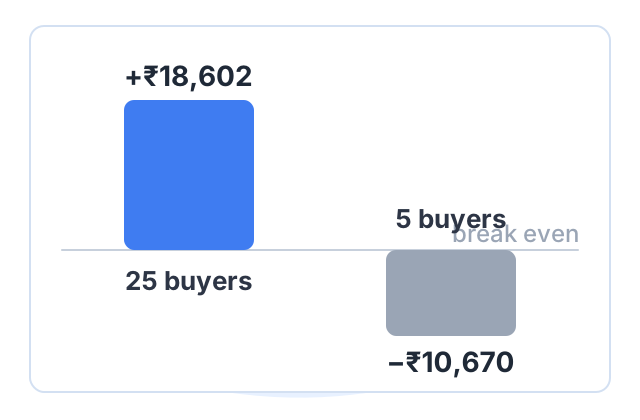
- Left: 37,475 − 885 − 17,988 = ₹18,602.
So route B produced about ₹2,600 more than route A, and took a year instead of two months. That is the honest shape of the comparison, not a win.
What changes it. The 40 hours in route A are spent. The 40 hours in route B are not: in year two the course can sell again, and only the ₹17,988 subscription repeats. Two years of route A costs 80 hours; two years of route B costs 40.
What breaks it. Run the same arithmetic with five buyers instead of twenty-five: 5 × ₹1,499 = ₹7,495, minus ₹177 in processing and ₹17,988 in subscription, and you are down about ₹10,670. Nothing about the course changed. Only the number of people who found it changed. That is why an audience, not the recording, is the hard part — and why most people should earn in group one while building the audience that group two needs.
The honest warnings
Anything promising money with no skill and no audience is selling you something. The kit, the course on selling courses, the “system” with a joining fee: the money in those moves from you to them. If a scheme pays you for recruiting others rather than for selling something to a customer, walk away.
Group two earns nothing for a long time. Months, not weeks, and sometimes nothing ever. Do not quit anything, borrow anything or count on it in a budget until it has actually paid twice.
Tax applies. Side income is income. Keep a record of what came in and what you spent from the very first rupee, including platform fees and subscriptions, which are usually deductible costs. GST may apply depending on what you sell and your turnover. Ask a chartered accountant before the income grows, not after.
Your employer may have rules. Many employment contracts in India restrict outside work or work in the same field. Read yours before you advertise, not after a client posts a testimonial with your name on it.
Sell a course on Courselink
If the skill you picked is one you can teach, a recorded course is the version of it where the hours are spent once. Courselink is where you host it: you upload your lessons or paste YouTube links, students get their own login, and you keep what you charge — Courselink takes 0% commission on every plan, while your payment provider charges its own processing fee.
The Free plan publishes 2 free courses for up to 100 students, which is enough to build the thing and share it. Selling starts on Lite ($19 a month, ₹1,499 a month), which adds paid courses, Stripe, Razorpay and Sepay, coupons and sales analytics. A custom domain comes on Standard. See pricing for the full comparison, and Courselink for teachers if you are already tutoring and want to stop repeating the same lesson.
Where to go next
If you are leaning toward teaching, teach online and earn money compares tutoring, live classes and recorded courses in more detail, including what each one asks of you week to week. More guides in this series are on the make money with what you know hub.
Sources
The payment-processing figure on this page — a 2% standard rate per transaction, plus 18% GST on that fee — comes from Razorpay’s own pricing page, checked in October 2026. The same page lists UPI at 0% MDR for most transactions, so the worked example above assumes card payments and is the more expensive case. Rates change; check it before you price anything.
Every other number here is arithmetic from assumptions stated beside it. This page publishes no average earnings, no hourly rates for any trade and no claim about how much any idea pays, because those figures vary by city, skill and audience, and no honest source exists for them.