

A coaching business online needs three things: a specific person you help with a specific problem, a way for them to book and pay you, and a way to deliver the work. The first of those decides the other two, so do it first and do it narrowly.
Most people get this backwards. They pick the tools, build a website, and only then try to work out who it is for. The order below is the one that saves the most wasted work, and most of it has nothing to do with any particular product.
Start with one client and one outcome
The test is simple. Can you name the client and the result in one sentence, without naming your method?
“I help newly promoted engineering managers get through their first six months without losing their best people” passes. “I offer transformational leadership coaching” does not, because it names a method and no one in particular.
This matters for a practical reason, not a philosophical one. Everything downstream is easier when the sentence is narrow. You know which rooms to be in. You know what to write about. You know what to charge, because you know what the client is comparing the fee against. And the client can repeat the sentence to someone else, which is how referrals actually travel.
Two useful questions if you are stuck. What problem have people already asked you about for free? And which version of that problem is expensive enough that someone would pay to fix it? The overlap is your starting niche. You can widen it later; almost nobody succeeds by starting wide.
What qualifications actually matter
This is where honest advice is hard to give in general terms, because the answer genuinely depends on where you live and what you coach.
Some fields adjacent to coaching are regulated by law in many countries — mental health care, nutrition and dietetics, medical advice, financial advice. In those fields what you may call yourself, and what you may advise on, is restricted, and the restriction applies regardless of what you name your service. If your work sits anywhere near one of those, find out the rules in your country before you write your first page of copy. That is a question for a local professional body or a lawyer, not for an article.
In niches that are not regulated — business, career, leadership, productivity, creative work — there is no license to obtain, and certifying bodies exist but are voluntary. Requirements, costs and recognition vary by country and by body, so check the organization that matters in your niche and your country on its own website rather than taking a figure from a blog. We have deliberately not listed any body’s requirements here, because they change and because recognition is not uniform across countries.
What clients tend to weigh instead, in unregulated niches: whether you have done the thing you are coaching, whether you can describe a past client’s situation in enough detail that it sounds real, and whether someone they trust will vouch for you. References do more work than certificates. A certification can still be worth having — for the training itself, for the structure, for your own confidence — but treat it as a thing you do for your practice, not as the thing that unlocks clients.
Pricing: package, not hour
Price a result, not a block of time. “Six sessions over three months, with written feedback between them, to get X done” is a package. “$150 an hour” is a timesheet.
Three reasons the package wins. The client is buying the outcome, so the unit should match. It stops the conversation about whether a session ran fifty minutes or seventy. And it lets you get faster without getting poorer — under an hourly rate, every improvement in your own skill cuts your income.
The second question is what the client is comparing your price against. A manager paying for themselves is comparing it with a holiday or a course. A company paying for that same manager is comparing it with the cost of losing them. Same work, very different ceiling. Find out who signs the invoice before you set the number.
The hard ceiling to understand early: one-to-one coaching caps out. Your income is your rate times the hours you are willing to sell, and the hours do not increase. Raising the rate works for a while and then stops. That constraint is the reason the next section exists. If you want the same reasoning applied to recorded products, our guide to online course pricing covers how to set a number when there is no hour attached to it at all.
Getting the first clients
This is the hardest part, and most advice about it is dishonest. So, plainly: no platform supplies clients. Not a website, not a course tool, not a directory. Every tool you buy is downstream of demand you created yourself.
Realistically there are four sources at the start.
People who already know you. Former colleagues, former managers, people from your industry. Not a broadcast post — a specific message to a specific person saying what you are now doing and who it is for. Most first clients come from this list.
Referrals. Every client you finish well is asked, once, whether they know someone with the same problem. This only works if your one-sentence description is repeatable, which is why the niche comes first.
A narrow public body of work. Write or record about one problem, repeatedly, in the place your client already reads. The point is not reach. The point is that when someone with that exact problem finds you, there is enough evidence that you understand it for them to send a message.
Direct outreach. Specific, researched, short, and about their situation rather than your service. This has a low response rate and still works, because it is the only source that does not require waiting.
Expect the first three to six months to be mostly this. Budget for it the way you would budget for building the product, because it is the same kind of work.
The delivery stack, by function
New coaches often look for one product that does all of this. In practice these are four separate jobs, and most coaching practices use a different tool for each.
Where the calls happen. A video conferencing tool. Whatever you already use is almost certainly fine.
Where scheduling happens. A booking tool that shows your availability and writes to your calendar, so you stop trading messages about times.
Where payment happens. A payment processor, either directly or through whatever you sell through. This is the piece with a real, published cost — see the arithmetic below.
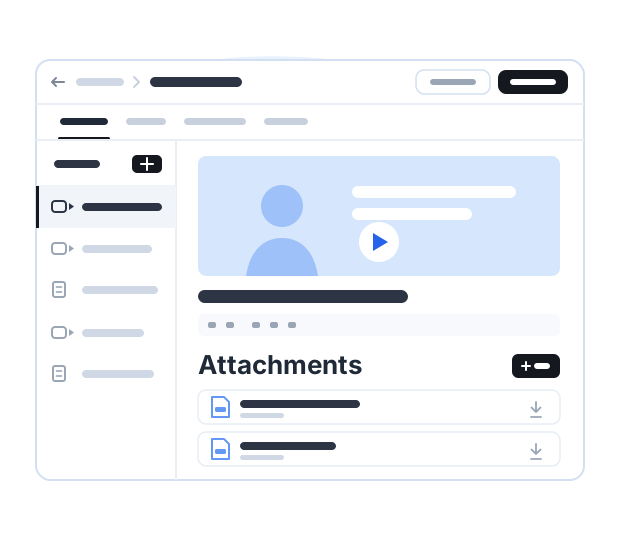
Where the material between sessions lives. Pre-work, worksheets, recorded explanations of the things you say to every client, assignments, and a record of who has done what. This is the part most coaches leave scattered across email attachments and shared drives for far too long.
Keeping them separate is normal, not a failure. The thing to check is that the client’s experience does not feel like four unrelated products — one clear starting point and consistent naming does most of that work.
How a coaching business stops trading hours for money
There are three shapes, and each one buys scale by giving something up.
One-to-one gives the client your full attention and gives you the highest price per person. It does not scale, and it stops entirely when you are ill or on holiday.
Group programs run the same curriculum with six or twelve people at once. You earn more per hour delivered and clients get peer accountability, which is sometimes worth more than your advice. You give up the ability to go wherever an individual’s situation leads, and you take on cohort scheduling, which is its own administrative burden.
Recorded, self-paced programs remove the hour entirely. The same explanation you have given forty times gets recorded once, and the client works through it when they can. You give up diagnosis — a recording cannot notice that the client has described the wrong problem — and you take on the full cost of getting buyers, which no longer arrives through a conversation.
Most practices end up mixed: a small number of one-to-one clients at a high price, a recorded program doing the teaching that does not need to be live, and the live time spent on the part only you can do.
A worked example
This is arithmetic from assumptions stated here. It is not a forecast, an average or a claim about what coaches earn.
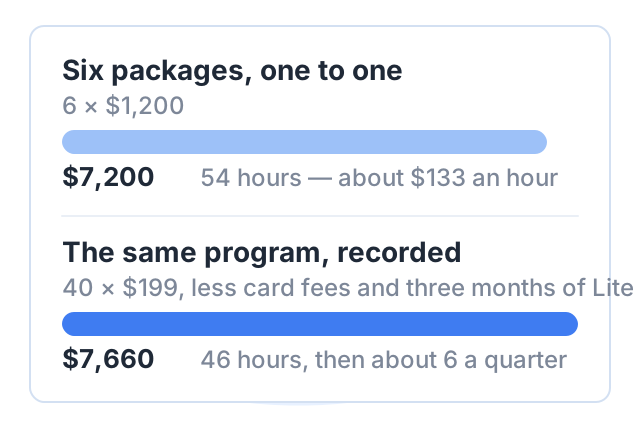
Assumptions. A six-session package priced at $1,200. You sell and deliver 6 packages in a quarter. Each session is one hour, plus an assumed 30 minutes of preparation and notes.
- Revenue: 6 × $1,200 = $7,200
- Hours: 36 session hours + 18 hours of preparation = 54 hours
- Per working hour: $7,200 ÷ 54 = about $133
Now the recorded version. Assume you record the same program once and price it at $199, and assume 40 people buy it in the quarter. Forty buyers is an assumption, not a projection — it is the number you control least.
Stripe’s standard US pricing is 2.9% + 30¢ per successful transaction for domestic cards, from Stripe’s own pricing page, checked October 29, 2026.
-
Gross: 40 × $199 = $7,960
-
Processing: ($199 × 2.9% = $5.77, + $0.30) × 40 = $242.84
-
Courselink Lite at $19 a month for three months = $57. Courselink takes 0% of the sale itself.
-
Net: $7,960 − $242.84 − $57 = about $7,660
-
Hours: an assumed 40 hours to script, record and assemble, plus an assumed 2 hours a month answering questions = 46 hours in the first quarter, and roughly 6 hours in any later quarter it keeps selling.
What this leaves out, and it is a lot: tax, refunds, the cost in money or months of finding 40 buyers, international card surcharges and currency conversion, your other tools, and whether the program sells at all in a second quarter. The comparison is only useful for the shape it shows — the one-to-one number is reliable and capped, the recorded number is uncapped and uncertain.
Sell a course on Courselink
Courselink is where the material between sessions can live: the pre-work, the recorded explanations you repeat to every client, attached worksheets, assignments and a record of who has completed what. The live calls stay exactly where they are now — Courselink holds recorded material and files, and has no video calls, live classes or booking calendar.
Two ways coaches use it. An invite-only course, where you add clients one at a time so only your current clients can see the program, available from Lite ($19 a month). Or a paid, self-paced version of your signature program sold publicly — also from Lite, which is where paid courses and Stripe, Razorpay and Sepay payments start. The Free plan publishes free courses only and cannot sell.
Courselink takes 0% of every sale on every plan; your payment provider charges its own processing fee. See pricing for the plans, and Courselink for coaches for how a coaching program is set up.
The legal and admin basics
General pointers only — these are the items to take to someone qualified in your country, not things to settle from an article.
A written agreement, even a one-page one, for every client. What you will do, over what period, what the client is responsible for, and what happens to the fee.
Scope. Write down what is included and what is not. The most common source of resentment in coaching is the slow expansion of “quick questions” between sessions into unpaid work.
Cancellation and rescheduling terms. Decide the rule before you need it, state it at the start, and apply it the same way to everyone.
Tax and business structure. How you register, what you must charge on top of your fee, and what you must set aside all depend on where you and your client are. Sales tax and VAT rules for digital products in particular differ from the rules for a live service. Get local advice before your first invoice, not after your first year.
Confidentiality and client records. Decide what you keep, where, and for how long, and tell clients.
A sequence you can start this week
- Write the one-sentence description. Name the client and the result, not your method.
- Check the rules in your country for your specific niche, before you describe yourself in a particular way.
- Price one package, not an hour, and work out who signs the invoice.
- Message ten people who already know you. Specifically, not as an announcement.
- Pick the four tools by function — calls, scheduling, payment, material — and accept that they are four.
- Record the explanation you have already given three times. That recording is where the non-live part of the business starts.
More guides on earning from what you already know are in our make money with what you know hub.
Sources
- Payment processing figures: Stripe pricing, US standard pricing, 2.9% + 30¢ per successful transaction for domestic cards, checked October 29, 2026.
Every money figure on this page is arithmetic from assumptions stated beside it, not an average, a benchmark or a forecast. This page names no coaching certification body and quotes no body’s requirements, because recognition and rules vary by country and by niche — check the organization that matters in yours, on its own website.