

Shorts earn money from one monthly pool, not from ads attached to your individual video. YouTube collects the ad revenue from the Shorts Feed each month, splits part of it out to pay for music licensing, and allocates the rest to monetizing creators by their share of engaged views. Of the amount allocated to you, you keep 45%.
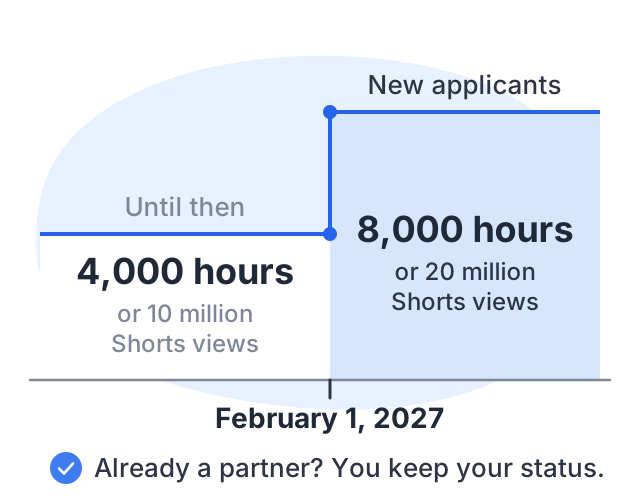
To get any of it you have to be in the YouTube Partner Program at the ad revenue tier: 1,000 subscribers plus either 4,000 qualified watch hours in the last 12 months or 10 million qualified Shorts views in the last 90 days (YouTube, as of October 2026).
How the Shorts Creator Pool works
Long-form monetization is simple to picture. An ad runs on your watch page, that ad earns money, and you take a share of it.
Shorts do not work that way. Ads appear between videos as a viewer swipes, so no single ad belongs to a single Short. YouTube’s answer is to pool the revenue and divide it afterwards.
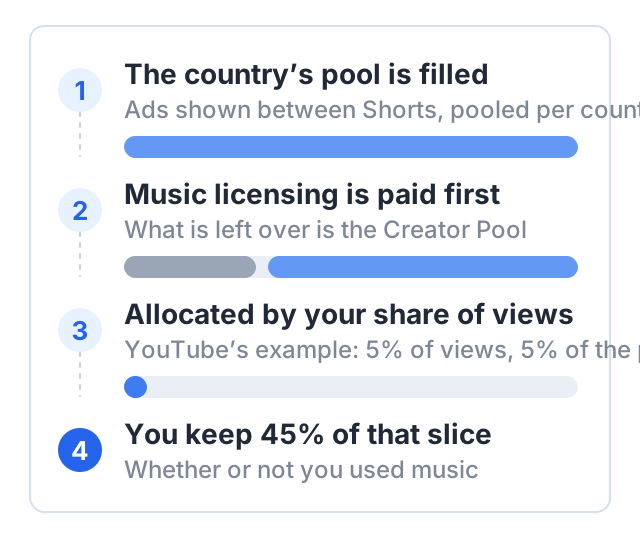
Three steps happen each month:
- The pool is filled. Revenue from ads between videos in the Shorts Feed goes into a pool, per country.
- Music is paid for first. Part of the pool covers music licensing. What remains is the Creator Pool.
- The pool is allocated by engaged views. Your allocation is your share of the total engaged views from monetizing creators in that country. YouTube’s own example: a creator with 5% of those views is allocated 5% of the Creator Pool.
Then the revenue share applies. YouTube states that “monetizing creators will keep 45% of their allocated revenue, regardless if music was used or not” (YouTube Shorts monetization policies).
The same 45% applies to the Premium side. YouTube pays 45% of the net YouTube Premium revenue allocated to monetizing creators for Shorts.
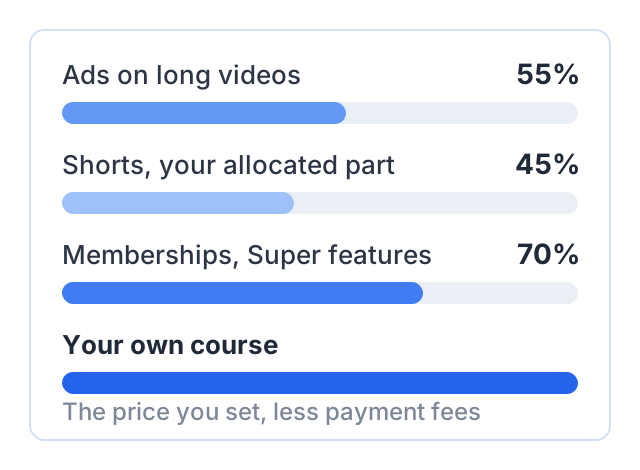
45% for Shorts, 55% for long-form
YouTube publishes both shares on the same page. For long-form, “YouTube will pay them 55% of net revenues from ads displayed or streamed on their public videos on their content Watch Page.” For Shorts, “YouTube will pay them 45% of the revenue allocated to them based on their share of views from the Creator Pool allocation” (YouTube partner earnings overview, as of October 2026).
Read those two sentences closely, because the percentage is the smaller difference. The 55% is taken from the ads on your own page. The 45% is taken from a slice of a shared pool that was already reduced by music licensing before you were allocated anything. Two different bases, not just two different rates.
The two pots stay separate. YouTube says Shorts views “exclusively receive ad revenue sharing from the Shorts Feed,” which is separate from long-form monetization on the watch page. A Short does not add to your long-form ad revenue, and watch time from the Shorts Feed does not count toward the 4,000-hour threshold either.
What a Shorts channel has to clear
There are two tiers, and Shorts views open both of them.
Ad revenue tier. 1,000 subscribers, plus either 4,000 qualified watch hours in the last 12 months or 10 million qualified Shorts views in the last 90 days. This is the tier that includes the Shorts Creator Pool and Premium revenue.
Fan funding tier (the expanded Partner Program). 500 subscribers, 3 valid public uploads in the last 90 days, plus either 3,000 qualified watch hours in 12 months or 3 million qualified Shorts views in the last 90 days. This unlocks memberships, Super Chat and Super Stickers, Super Thanks, jewels and gifts, and Shopping — your viewers paying you, not YouTube paying you. India is one of the countries where this tier is available (Overview of the expanded YouTube Partner Program).
Both sets of numbers are from YouTube’s help pages as of October 2026. Our guide to the monetization rules covers the account requirements that also apply, such as 2-Step Verification and no active Community Guidelines strikes.
Two changes are already published for February 1, 2027.
Why Shorts pay far less per view
Nobody can tell you what a Short pays per view, because YouTube publishes no per-view rate. Any number you see in a blog post is an estimate made from someone else’s channel. Three mechanisms explain the gap without needing one.
Fewer ads per minute of attention. A viewer gives a long video several minutes and can see several ad breaks. The same viewer gives a Short a few seconds, and the ads sit between videos rather than inside yours.
You are paid from a divided pool, not from your own page. Your allocation falls when other monetizing creators in your country post more Shorts, even if your own views are flat. Long-form revenue does not move that way.
The pool is reduced before you are allocated anything. Music licensing comes out first.
To see your own figures rather than somebody else’s, open YouTube Studio and go to Analytics, then the Revenue tab. YouTube Analytics shows estimated daily Shorts Feed ad revenue, and RPM — which YouTube defines as “how much money you’ve earned per 1,000 video views”, calculated per 1,000 engaged views for Shorts and measured after YouTube takes its share (RPM, YouTube Help). YouTube publishes no average or benchmark RPM, and says the figure varies with the time of year, where your viewers are, and the ad format. Your own number is the only one worth planning around.
What music does to the split
This is the part most explanations get backwards. Music affects the pool, not your allocation.
If a Short uses no partner music, all of the revenue tied to it goes to the Creator Pool. With one music track, half goes to the pool and half to music partners. With two tracks, one third goes to the pool.
But YouTube is explicit that each monetizing creator is allocated 100% of their engaged views regardless of whether music was used, and that the 45% rate does not change. Only music from YouTube’s music industry partners or Dream Track reduces a Short’s contribution in the first place.
So using a trending track does not cut your personal earnings. It makes the pool everyone draws from a little smaller.
What a Shorts-heavy channel can realistically do
Ten million qualified Shorts views in 90 days is a high bar, and it is now also a monthly bar from February 2027. That makes it worth being honest about where the money actually comes from.
Route the audience to long-form. The 55% share applies to a watch page, not to the feed. A Short that ends by naming the full video moves a viewer from the lower-paying format to the higher-paying one.
Get to 500 subscribers and take the fan funding tier. Super Thanks and memberships are paid by your viewers, and the threshold is half of the ad tier’s.
Use the routes that need no approval at all. Sponsorships, affiliate links and your own product have no subscriber threshold, because YouTube is not part of the transaction. Our guide to making money without monetization covers how to start each one, and the rest of the YouTube money hub covers the surrounding rules.
The useful question is not how to squeeze more out of the pool. It is what a viewer who watched thirty Shorts would pay you for directly.
Another way to earn: sell a course
Shorts are good at reach and weak at revenue per view. A course inverts that: fewer people, far more per person, and no threshold or approval from YouTube.
Courselink turns a playlist you have already published into a paid course site. Paste your YouTube links, the lessons import in order, and students pay into your own Stripe or Razorpay account, with Courselink taking 0% of every sale. The payment provider still charges its own processing fee.
You can build the course free — the Free plan publishes 2 free courses for up to 100 students, with unlimited YouTube lessons. It cannot sell, though: paid courses, payment providers and coupons start on Lite at $19 a month, and your own domain on Standard. See pricing for what each plan includes.
Sources
Every figure on this page comes from YouTube’s own help pages, checked as of October 2026:
- YouTube Shorts monetization policies — the Creator Pool, the engaged-views allocation, the 45% share, the music splits and the February 1, 2027 pool requirement.
- YouTube partner earnings overview — the 55% long-form share and the 45% Shorts share.
- YouTube Partner Program overview and eligibility — 1,000 subscribers with 4,000 watch hours or 10 million Shorts views.
- Overview of the expanded YouTube Partner Program — the 500-subscriber tier and its 3 million Shorts views route.
- Changes to the YouTube Partner Program — the February 1, 2027 thresholds and the ongoing Creator Pool requirement.
- RPM — the definition and where it appears in YouTube Studio.
This page quotes no per-view rate, RPM or earnings estimate for Shorts, because YouTube publishes none. What any channel earns depends on its country, its audience and the month.