

The digital products that earn the most are not the ones that are easiest to make. What a digital product earns is its price, multiplied by how often it sells, multiplied by how little work each sale costs you — and those three pull against each other.
A small template is quick to make and quick to buy, but needs hundreds of buyers to add up. A paid audit pays well on the first sale and nothing when you are not working. A course sits between them, which is why it tends to earn the most per buyer. Below are the products worth selling, grouped by type, each judged on the same three things.
The three things that set what a product earns
Run these three on every idea before you build it. They explain most of the difference between a product that earns and one that does not.
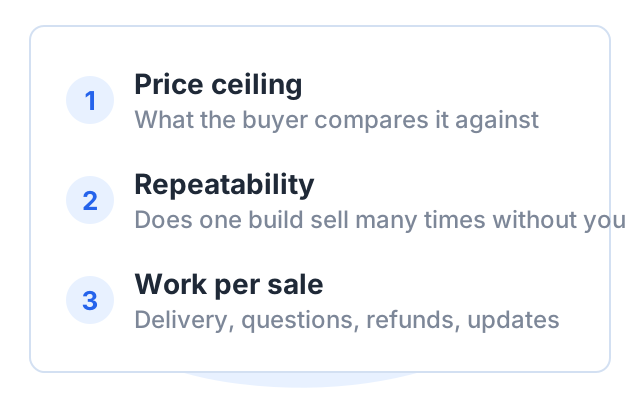
Price ceiling — what the buyer compares it against. Price is set by the nearest alternative in the buyer’s head, not by how long the thing took you. A spreadsheet template competes with free spreadsheet templates, so its ceiling is low however good it is. A course that gets someone a result competes with months of figuring it out alone, or with hiring somebody, so its ceiling is far higher. To raise your price, change the comparison.
Repeatability — does one build sell many times without you. A file you upload once can sell while you sleep. A live session sells once. Repeatability separates a product from a job, and it is why a modest price can still matter.
Work per sale. Delivery, questions, refunds, customization, updates. A font generates almost no email; a done-for-you setup generates a conversation every time. Work per sale is the hidden tax that turns a good-looking price into an ordinary hourly rate.
A product strong on all three is rare. Most are strong on two, and the pair you pick decides what the business feels like.
Files you make once
The lowest work per sale, the lowest price ceiling, and the hardest volume problem.
Templates — resumes, invoices, budget sheets, post layouts, slide decks, contract drafts. The buyer compares them against free versions and against twenty minutes of their own time, so the ceiling stays low. They suit people who already build these files for their own work. The real work is not the template but the instructions, because a template nobody can customize gets refunded.
Presets and filters — photo presets, video LUTs, audio presets. Priced low for the same reason: free ones exist. They suit photographers, editors and musicians with a visible body of work, because the sample images are the sales pitch. The real work is making them hold up on other people’s footage, not just yours.
Printables — planners, worksheets, wall art, checklists, classroom material. Low ceiling, almost zero work per sale, and the clearest example of a volume product. The real work is producing enough of them that search can find you.
Stock assets — photos, video clips, loops, sound effects, 3D models, mockups. These earn per download, usually through a marketplace that sets the rate. They suit people who produce this material anyway as a by-product of client work. The real work is quantity and keywording: a library habit, not a launch.
Fonts and icon sets — a higher ceiling than most files, because a business buying a license is comparing against commissioning one, and because licensing lets you charge more for commercial use. The real work is the breadth of the set and the license terms, which you write down before you sell, not after.
Written work
A higher ceiling than files, because the buyer is paying for your thinking rather than for an asset.
Ebooks and guides — the ceiling depends almost entirely on the subject. A general ebook competes with cheap books and free articles. A guide to one expensive problem, written for a named group of professionals, competes with nothing in particular and can carry several times the price. The real work is the writing, and the honest test is whether a reader could get the same answer from a search.
Notion systems and spreadsheet systems — a template with a method attached. The ceiling is higher than a plain template because the buyer is paying for the structure and the decisions inside it, not the file. They suit people who have run the system themselves for a year. The real work is support: buyers break the system and write to you.
Swipe files and reference packs — collections of examples, scripts, sequences, prompts. Low to middling price, because the buyer can imagine assembling one themselves. They suit people with access to material others cannot see, and the real work is curation: a pack that goes stale earns refunds.
Taught material
The high-price, repeatable corner. This is where most of the per-buyer earnings sit.
Online courses — the buyer is paying for an outcome and for the order of the steps, which is a different purchase from a file. That is why the ceiling is high: you are compared against the cost of working it out alone, a classroom course, or hiring a person for a day. A course suits anyone who can get a result and explain the sequence, and the real work is structure and completion, not video polish. If you have no subject yet, our list of online course ideas is organized by who buys them.
Workshops and short paid sessions — a higher price per head than a recording, but repeatability is zero unless you record it. They suit people testing a subject before building a full course, because two hours with real people shows you what is missing.
Paid tutorial series and lesson packs — narrower than a course and priced below one, because the buyer compares them against free tutorials on the same software. They suit people teaching one tool rather than one outcome, and the real work is keeping them current when the tool changes.
Certifications and assessments — a high ceiling when a specific industry recognizes them, close to zero when it does not. They suit people with standing in a field that already cares about credentials, and the real work is that standing, which no product page can create for you.
Access and membership
Memberships and subscriptions — the model that changes the arithmetic most, because one sale repeats monthly instead of once. The ceiling per month is low: the buyer compares it against other subscriptions they could cancel this evening. They suit people who publish continuously anyway. The real work is the treadmill — it must be worth paying for again every month, and churn is the number that decides whether it works.
Private or invite-only material — paid access to something limited, such as a library or an archive. The ceiling comes from scarcity rather than volume, and the real work is controlling access without annoying the people who paid.
Services, productized
The highest price per sale, and no repeatability at all.
Audits and reviews — a portfolio review, a website audit, a resume rewrite. Fixed scope, fixed price, delivered as a document or a recording. The ceiling is high because the buyer compares it against a consultant’s day rate. They suit anyone whose judgment people already ask for free. The real work is each delivery, every time.
Custom work at a fixed price — a logo, a report, an edit, a setup. The same arithmetic at a higher price and with more delivery work. The real limit is the number of hours in your week, and that limit never moves.
Templates plus setup — a file with your time attached: sell the file cheaply to many and the setup expensively to a few, so one audience supports two prices.
Software and tools
Plugins, scripts, small apps and extensions — a high ceiling when they save a business real money, and a long tail of maintenance when the platform underneath changes. They suit developers who already live in one ecosystem. Support and updates never end, so treat it as a product with a permanent staff cost of one person: you.
Which earns the most, and why
Run the three tests and the picture is consistent.
Low-price files need volume, and volume needs a distribution channel. A cheap template only becomes real money at a few hundred sales, and those do not happen by accident. You need an audience that already follows you, or a marketplace whose search brings buyers to you. A marketplace solves distribution, takes a cut, and fixes the price expectation near the bottom, because every competing listing sits on the same page. That is the trade: files are the lowest-effort thing to make and the hardest thing to sell on your own.
Taught material carries the highest price among products that repeat. Not because video is expensive to make, but because of the comparison. A file buyer compares against other files. A course buyer compares against the cost of not knowing: time wasted, a result not reached, or the fee of a person who would teach them directly. The same week of work priced as a template and priced as a course produces very different numbers, and the difference is the comparison, not the content.
Productized services pay the most per sale and nothing in between sales. An audit can earn more in one transaction than a hundred template sales, and exactly zero on the days you do not deliver one. Services are the most direct way to earn real money from a skill, and the slowest way to stop trading hours for it.
So the honest answer is conditional, and you should be suspicious of a single ranking. With no audience, a productized service usually earns most first, because one buyer is enough. With even a small audience, taught material usually earns most per buyer and keeps earning. Files earn least per sale in every case, and beat the others only when something else supplies the volume.
Most people who do well run two at once: a high-price item that pays now and a repeatable item that pays later. The hub on making money with what you know covers the routes that build the audience both depend on.
Which is easiest to start with
This is a different question, and the answers are nearly the reverse.
The easiest product to start with is a file you already made for yourself: one template, one checklist, one printable. One upload, nothing to support, publishable this week — and, by the arithmetic above, among the lowest earners per sale.
The second easiest is a productized service, because it needs no product at all: a fixed scope, a fixed price and a page describing both. It earns well immediately and never compounds.
A course is the slowest to start and the one most likely to still be earning in a year. A short course covering one outcome is a reasonable first attempt; a full curriculum usually is not, because you learn what the lessons should be only after real students take them.
Pick by the problem you have. If it is money this month, start with the service. If it is that your work does not accumulate, start with the course.
A worked example
This is arithmetic from the assumptions stated here, not a forecast or an average. The volumes are chosen to compare two shapes; nobody can tell you what you will sell.
Assume two products sold through Razorpay in India:
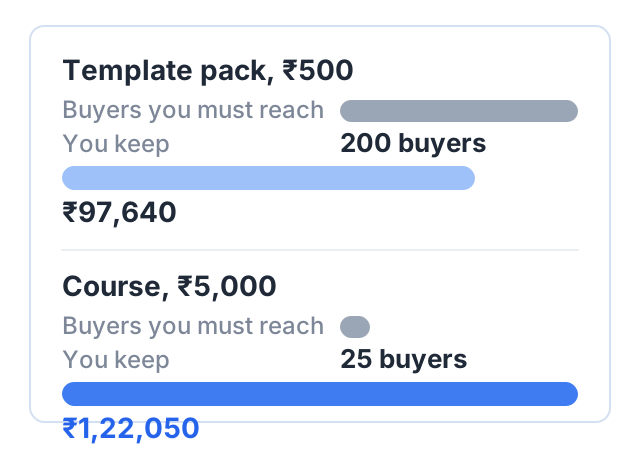
- A template pack at ₹500, selling 200 copies in a year → ₹1,00,000 collected.
- A course at ₹5,000, selling 25 seats in a year → ₹1,25,000 collected.
Razorpay’s published standard rate is 2% per transaction, with 18% GST charged on that fee (Razorpay pricing, checked October 2026), so the processing cost is 2.36% of what you collect if buyers pay by card. The same page lists UPI separately at 0% MDR for most transactions, so this is the more expensive case.
- Template pack: ₹2,000 fee + ₹360 GST = ₹2,360. You keep ₹97,640.
- Course: ₹2,500 fee + ₹450 GST = ₹2,950. You keep ₹1,22,050.
The course collects more, and it does it from 25 buyers instead of 200 — eight times fewer people to reach, persuade and support. That gap is the price ceiling doing the work, and it is the clearest argument for taught material over files.
Selling in another currency? Substitute your own provider’s published rate. Payment pricing differs by country — Stripe, for example, serves a separate rate sheet on each country’s version of its pricing page — so check the one for yours rather than copying a figure out of an article.
What this leaves out: income tax, any tax you owe on your own sales, refunds and chargebacks, your platform subscription, advertising, and your own time building and supporting either product. It also assumes both products sell at all, which is the assumption that fails most often.
What kills most digital products
Two things, and neither is the product.
No audience. The product is finished, the page is live, and nobody comes. This is the usual ending, and not a marketing problem you can fix after launch. Something has to send people: a following, search, a marketplace, a mailing list, a partner. Decide which before you build, and if the answer is “I’ll figure that out later”, build the smaller version.
A product nobody asked for. Built because it was interesting to make, not because anyone said they needed it. The test is the question people already ask you, repeatedly, in the same words. If you cannot name that question, you do not have the product yet. The cheaper test is to describe it to five people who fit the buyer and ask them to pay before it exists.
Everything else — price, platform, launch day — is small next to these two.
Sell a course on Courselink
A course sits at the high-price, repeatable corner of the framework, which is why it tends to earn the most per buyer. Courselink is where you publish and sell one: lessons in order on your own yourname.course.link site, students paying you directly through Stripe, Razorpay or Sepay. Courselink takes 0% of your sales on every plan — the payment provider charges its own processing fee, as in the example above.
You can build and publish on the Free plan, which covers 2 free courses for up to 100 students, 5 hours of uploaded video and unlimited YouTube lessons. The Free plan cannot sell: paid courses, payment providers, coupons, invite-only access and sales analytics all start on Lite, at $19 a month (₹1,499). A custom domain and removing Courselink branding start on Standard, at $49. See pricing for the full comparison, or the page for coaches if you already sell your time and want the repeatable version of it.
Sources
- Payment processing fees: Razorpay pricing, checked October 2026 — 2% standard domestic platform fee, plus 18% GST on that fee.
- Courselink plan limits and what each tier includes: course.link/pricing.
Price bands here are reasoning about what a buyer compares a product against, not market averages. Nobody publishes reliable average prices or sales volumes across digital product marketplaces, so this page quotes none.