

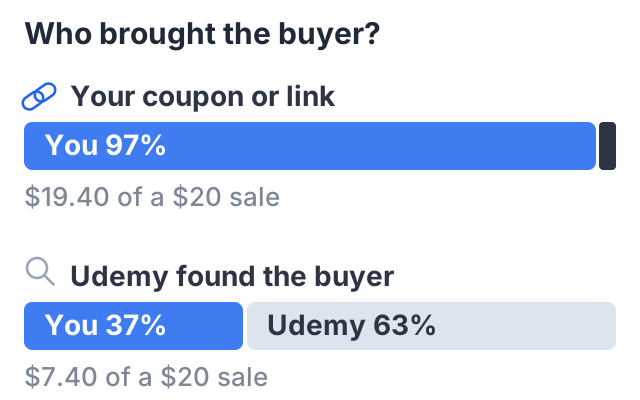
Selling on Udemy means publishing your course in Udemy’s marketplace, where Udemy finds buyers, sets most prices and pays you a share of each sale. That share is 97% when the buyer came through your own coupon or link, and 37% when Udemy found the buyer.
So the real question is not “Udemy or my own site”. It is “who will bring the buyers?” If Udemy brings them, it keeps most of the sale. If you bring them, your own course site lets you keep almost all of it, at a price you choose.
Below: how publishing and approval work, what Udemy pays on each kind of sale, and a like-for-like comparison with your own course site. The figures come from Udemy’s own instructor pages.
How selling on Udemy works
Udemy is a marketplace. Students search a large catalog, and your course sits beside others on the same topic. You do not pay a monthly fee. Udemy makes money by keeping a share of each sale.
The rules that matter most come from Udemy’s guide to pricing your course:
- To charge for a course, you must be a premium instructor. You apply, and Udemy approves you. There is no upfront cost.
- Free courses have limits. A free course cannot have more than 2 hours of video. It loses premium features such as Q&A and certificates of completion. And you can convert a course from free to paid only once.
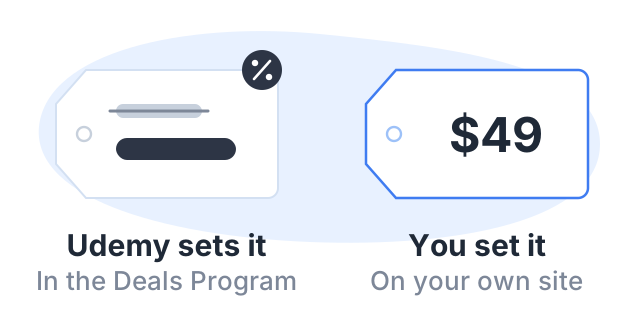
- Udemy can set your price. Premium instructors are opted into the Udemy Deals Program automatically. In that program Udemy sets the list price and offers your course at a discount during promotions. You set a backup price that shows where the program is not used.
- You can opt out of the Deals Program to keep control of your price. Udemy says removal from active promotions can take up to 10 days, and that opting out means less of the visibility the program gives.
What Udemy pays you
Udemy announced its current marketplace split in an update to its instructor terms, effective May 3, 2021:
| How the student bought | What you receive |
|---|---|
| Through your coupon or referral link | 97% |
| Any other marketplace sale, such as browsing Udemy or a Udemy ad | 37% |
Udemy also runs subscription plans, where students pay a monthly fee for a catalog of courses. Those pay instructors from a separate pool. In a later update, Udemy set that share at 20% from January 2024, 17.5% from January 2025 and 15% from January 2026. The same update said the 37% marketplace share was not changing.
Even at 97%, Udemy keeps a small part of the sale. The same 2021 update also mentions a 3% transactional fee in Udemy’s terms, which Udemy said it would apply consistently from then on.
How to sell a course on Udemy, step by step
- Create an instructor account on Udemy.
- Check the minimums before you record. Udemy’s help center says a course needs at least 5 lectures and 30 minutes of video to be approved for the marketplace, and its course quality checklist asks for HD video at 720p or 1080p and a course image of at least 2048 × 1152 pixels. Practice-test-only courses are the exception to the video minimum. Checked October 2026; Udemy publishes the current checklist in its instructor help center, and it is worth opening before you plan the recording rather than after.
- Send a test video. Udemy’s checklist describes a test video service that returns personalized feedback on your audio, video and presentation before you record the whole course. It is free, and it catches the problems — room echo, a backlit window, a microphone too far away — that are expensive to fix across 30 finished lectures.
- Build the course in Udemy’s course builder: sections, lectures and any quizzes.
- Apply to be a premium instructor so you can charge.
- Choose your pricing route. Stay in the Deals Program and let Udemy set the price, or opt out and choose a price tier yourself.
- Submit for review. Udemy runs a quality review against that checklist before a course goes live, so a course is not published the moment you finish it. Build the wait into any launch date you announce.
- Promote with your own coupons and referral links. These are the sales where you receive 97%, so every link you share from your own channels matters.
A worked example
Two things differ between Udemy and your own site — who found the buyer, and who set the price — so it is worth changing one at a time.
First, the same price on both sides
Say the course is $20 everywhere. These are example prices, not Udemy averages.
| Where and how the sale happens | Price | You receive |
|---|---|---|
| Udemy, buyer found you in the marketplace | $20 | $7.40 (37%) |
| Udemy, buyer used your coupon or referral link | $20 | $19.40 (97%) |
| Your own site, paid by card through your Stripe account | $20 | $19.12 after Stripe’s 2.9% + 30¢ |
At one price, the gap is not between Udemy and your own site. It is between a buyer Udemy found and a buyer you brought: $7.40 against roughly $19 either way. For the buyers you bring yourself, Udemy’s 97% is close to what your own checkout nets you, so the 63% share is not what you avoid by leaving — it only ever applied to the buyers the marketplace found.
What your own site costs that Udemy does not is the fixed plan fee: Courselink Lite is $19 a month whether you sell or not, while Udemy charges nothing until a sale happens.
Then, the price you control
The other difference shows up when you set the price. On your own site $49 means $49; inside the Deals Program, Udemy sets the list price and discounts it.
| Where and how the sale happens | Price | You receive |
|---|---|---|
| Udemy, buyer found you in the marketplace | $20 | $7.40 (37%) |
| Udemy, buyer used your coupon or referral link | $20 | $19.40 (97%) |
| Your own site on Courselink Lite, paid through your Stripe account | $49 | $47.28 after Stripe’s 2.9% + 30¢ |
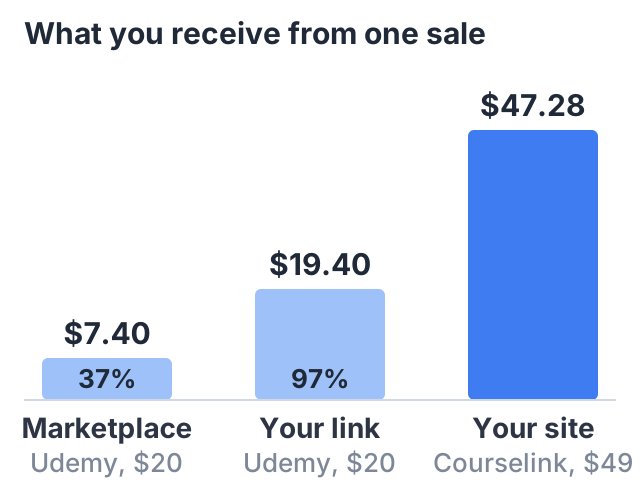
So the trade-off is in two parts. If you cannot bring buyers yet, 37% is the price of Udemy’s audience. If you can, the marketplace share barely matters, and what you are really choosing is who sets the price.
Where Udemy wins
Udemy is the better choice in four cases:
- You have no audience yet. Udemy’s marketplace has students already searching for courses. Your own site has no visitors until you bring them.
- You want no fixed costs. Udemy has no monthly fee. A course that sells nothing costs you nothing but your time.
- You do not want to market. Udemy’s promotions and the Deals Program sell for you, at a lower share.
- Students already trust the brand. Some buyers prefer a marketplace with reviews they can read.
Where your own website wins
- You already have an audience, and you would rather keep it on your own site. A YouTube channel, a newsletter or a client list means you bring the buyers — on Udemy those sales already pay you 97%, so the gain here is the price you can charge and the relationship, not the share.
- You want to set the price. On your own site, $49 means $49. No program discounts it without you.
- Your brand comes first. Students see your name and your site, not a catalog of competing courses beside yours.
- You want more than one kind of course. On your own site you can run invite-only courses for clients or a team next to public ones.
Using both
Some instructors use both. A short course on Udemy can help new people find you. Your full course, coaching or premium version lives on your own site, where you keep more of each sale.
If you plan to do this, read Udemy’s Instructor Terms and promotional policies first. They set the rules for what you may say and link to inside a Udemy course.
The Courselink way, side by side
| Udemy | Courselink | |
|---|---|---|
| Monthly cost | None | Free plan to build; Lite at $19 a month to sell |
| Who finds buyers | Udemy’s marketplace, or you | You |
| Your share of a sale | 97% via your links, 37% otherwise | 100% less card fees; Courselink takes 0% on every plan |
| Who sets the price | Udemy in the Deals Program, or you if you opt out | You |
| Where the money goes | Paid out by Udemy | Your own Stripe or Razorpay account |
| Your own domain | No | Standard ($49 a month) and above |
Courselink gives you your own course site: paste YouTube links or a playlist and the lessons import in order, with PDFs, quizzes, assignments and certificates. You can build the course free, but the Free plan cannot sell — charging starts on Lite at $19 a month, which also adds coupons and invite-only courses, and your own domain starts on Standard. Students pay into your own Stripe or Razorpay account and Courselink takes 0% of each sale. See the pricing page for every plan.
Courselink has no marketplace. It will not find buyers for you, which is a reason to keep Udemy in the mix while you grow. If your audience is on YouTube, read how to make money on YouTube without monetization. For other places to sell, see where to sell courses, or compare online course platforms by what each one costs.
Sources
- Udemy: Pricing your course: premium instructors, free course limits and the Deals Program.
- Udemy: Updating instructor business terms: the 97% and 37% shares and the 3% transactional fee.
- Udemy: Subscription terms update: the subscription share schedule.
- Udemy: Make the most of coupons and referrals: the 97% share on instructor promotions.
- Udemy’s instructor help center and course quality checklist, checked October 2026: the 5-lecture and 30-minute minimums for marketplace approval, HD video, the 2048 × 1152 course image and the test video service.
- Stripe pricing: the standard US card rate.
The worked example uses stated example prices, not Udemy averages or a forecast of what any course will earn. Udemy does not publish an average sale price on these pages, so this page does not quote one.