

A good course description tells the reader who the course is for, what they will be able to do at the end, and what is inside. The simple formula is: student + result + how it works + what is inside + why you.
Here is that formula filled in, before the explanation of why each part is there. Every sample in this article is written by us as an example, not a real course.
Sample 1: a software skill
Short: For office managers who use spreadsheets every day. Build five working spreadsheets, from staff schedules to monthly reports, starting from a blank file.
Long:
This course is for office managers and admin staff who use spreadsheets but feel slow at it. By the end, you will build five spreadsheets that small offices use every week: a staff schedule, an expense tracker, a supplier list with lookups, a clean data sheet and a monthly report.
The course has 5 sections and 18 short video lessons. Every lesson comes with a practice file, and each section ends with a quiz.
You will learn to:
- Clean messy data quickly
- Use lookups to connect two lists
- Build a report that updates itself each month
I have worked as an office manager for twelve years and trained new staff on these exact sheets.
The other five samples are further down, after the formula.
Short and long: you need two descriptions
Most course platforms ask for a description in more than one place.
- The short description is one or two sentences. It appears on course cards, under the title and when someone shares the link. Its only job is to make the right person click.
- The long description is the overview on your course page. It has room for the full formula. A useful range is about 100 to 250 words. Go longer only if the course is long or expensive.
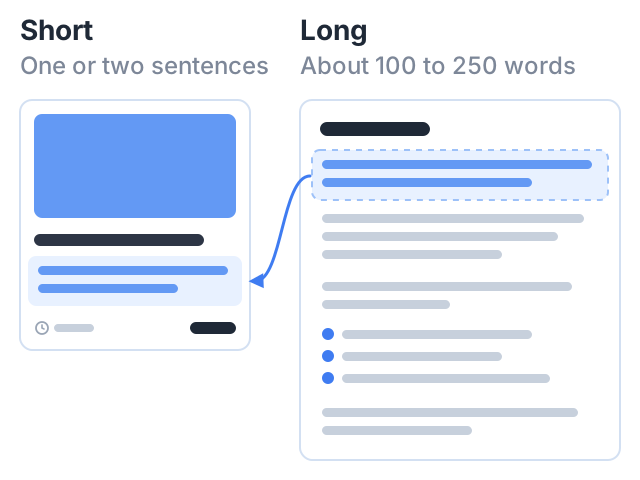
Write the long one first. The short one is usually its first two sentences, trimmed.
The formula, part by part
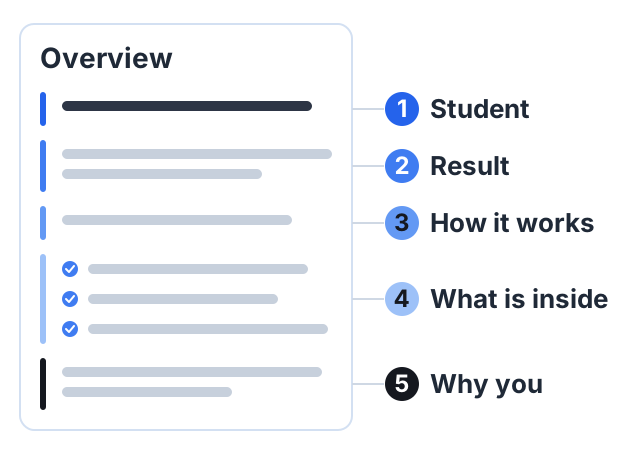
1. The student
Name who the course is for, as precisely as you can. “Beginners” is weak. “Adults who have never painted” is strong. A precise student also tells the wrong people to look elsewhere, which saves you refunds.
2. The result
Say what the student will be able to do at the end. Use an action verb you could check: send, build, paint, run, cook, pass. Avoid “understand”, “master” and “learn about”, because they promise nothing a buyer can see.
This is the same idea teachers use when they write learning objectives with Bloom’s taxonomy. Many universities publish lists of action verbs you can borrow.
3. How it works
Format, size and pace. Number of lessons or sections, video or text, worksheets, quizzes, and how long students have access. Facts here remove doubt.
4. What is inside
Three to six outcomes or modules in a short list. Readers scan lists. Paragraphs of features get skipped.
5. Why you
One to three sentences on why you can teach this. Your experience, your results, or how many years you have done the thing. Keep it true and short. The course is about the student, not you.
Five more samples by course type
Sample 2: a creative hobby
Short: Watercolor for adults who have never painted. Finish a small landscape you are happy to frame.
Long:
If you have always wanted to paint but do not know where to start, this course is for you. You will begin with three tubes of paint and finish by painting a small landscape from a photo.
There are 5 sections and 16 video lessons, each one short enough to watch before you paint. Every section ends with a small exercise you can share for feedback.
You will learn to:
- Mix greens, grays and browns from three colors
- Paint flat and graded washes for skies
- Paint trees and water with three simple strokes
I have taught beginner watercolor classes at a local art center for six years.
Sample 3: a fitness program
Short: A beginner running plan for people who cannot run for five minutes yet. Train toward your first 5K at your own pace.
Long:
This course is for complete beginners. You do not need to run now. You will follow a step-by-step walk-run plan, with a short video for each week explaining what to do and why.
Inside: a weekly plan, warm-up and stretching videos, and a simple log to track your runs.
Everyone progresses at a different speed, so take the weeks at the pace your body allows. Speak to a doctor before starting if you have a health condition.
Notice what this one does not say: no promised weight loss, and no promised finish time.
Sample 4: a money or business skill
Short: Bookkeeping for US freelance designers. Close your month in one evening and hand your tax preparer clean numbers.
Long:
This course is for freelance designers who put off their books until tax season. You will set up a simple system, send invoices that are easy to pay and do a monthly close in one evening.
5 sections, 14 lessons, a spreadsheet template and a monthly checklist.
This course teaches bookkeeping habits. It is not tax or legal advice. For your own tax situation, speak to a qualified tax professional.
Sample 5: a career skill
Short: Practice nursing job interviews with real question types, model answers and a plan for your own stories.
Sample 6: a parenting topic
Short: A calm, step-by-step plan for parents of toddlers who are starting potty training.
Samples 5 and 6 are short only, which is the point of including them: when a short description names the student and the result in one sentence, it can carry a course card on its own. Write the long version when the buyer has more to decide.
Worked example: rewriting a weak description
Here is a made-up “before” description:
Welcome to the Ultimate Photography Masterclass! In this comprehensive course you will learn everything about photography. Master your camera, understand light and become the photographer you were meant to be. Join thousands of happy students today!
What is wrong with it:
- No student. Is it for beginners, wedding photographers or phone users?
- No checkable result. “Master” and “understand” are not things a buyer can see.
- Nothing about the format. How many lessons? What do you get?
- An unsupported claim. “Thousands of happy students” must be true and provable, or it should not be there.
After:
For Etsy sellers who take product photos with a phone. By the end of this course, you will shoot clean, bright product photos on a plain background, using a window and a sheet of white card.
4 sections, 12 short lessons and a shot-list checklist you can print.
You will learn to:
- Set up a small photo corner for almost no money
- Use window light without harsh shadows
- Edit a photo in a free phone app in two minutes
I have shot product photos for small online shops for eight years.
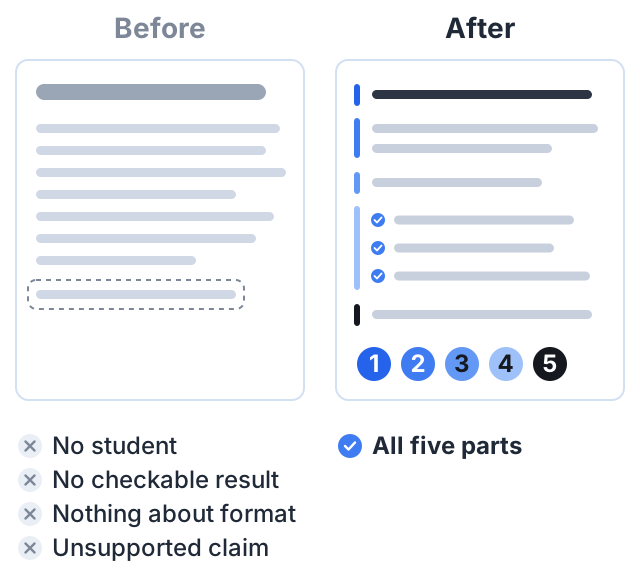
The topic is the same. The rewrite is shorter, more specific and easier to trust.
Claims to leave out
A course description is an ad, and US advertising rules apply to it.
- Income promises. “Earn $5,000 a month” is a claim you must be able to back up. The FTC’s Endorsement Guides, revised in 2023, say that when a testimonial shows unusual results, the ad must make clear what results people can generally expect.
- Fake or bought reviews. In August 2024 the FTC announced a final rule banning fake reviews and testimonials, including AI-written ones.
- Health results. Do not promise weight loss, cures or recovery times.
- Student numbers you cannot show. If you write a number, be ready to prove it.
Your description in search results
Your short description can also become your page’s meta description. Google says it sets no maximum length for meta descriptions, but cuts long ones to fit the screen, and often writes its own snippet from the page. Make each one unique and accurate. See how the description fits the rest of the page in our course landing page examples.
How to do this on Courselink
In Courselink, each course has a title, a subtitle for the short description, and an overview section on the landing page for the long one. You can also turn on a “what you will learn” section for your outcome list. In the course settings, you can set a separate meta title and meta description for search results, and a URL slug.
If you import a YouTube playlist, the lesson titles and descriptions come with it, so check that they still read well inside a course.
All of this works on the Free plan, where you can publish free courses at yourname.course.link; the Free plan cannot sell, so charging for a course starts on Lite at $19 a month and a custom domain on Standard, with 0% commission on every plan. See the pricing page. Still choosing a topic? Start with our online course ideas.
Sources
- FTC’s Endorsement Guides: What People Are Asking — testimonials that show unusual results.
- FTC announces final rule banning fake reviews and testimonials, August 14, 2024.
- Google Search Central: control your snippets in search results.
- Revised Bloom’s taxonomy action verbs, Old Dominion University.
Every course, teacher detail and number in the sample descriptions is made up for this article.